Showing posts with label Montgomery Burns. Show all posts

Thursday, September 3, 2009

Relationship between the Sox, media and fans tense and timeless

You can say anything you want about me and my writing, but if you badmouth Extreme we'll have a lot more than words between us. Photo from this site.

The best thing about finishing Fighting Words and seeing it hit the shelves (buy it here!)—other than living a cross-continental life of fame and fortune and having Jennifer Aniston on speed dial (OK that’s a lie, but I’m apparently following Wyclef Jean on Twitter and I can tell you he never shuts up)—is the absence of dread on mornings like last Thursday, when the Boston Herald’s Michael Silverman wrote a column criticizing the Red Sox’ recent sensitivity towards the media’s coverage of the team.

Three years ago, or even a year ago, such a piece would have filled me with panic. What if someone else decides it’d be interesting to write a book about the dynamic between the Red Sox and the media? And what if that someone else is able to, you know, author the book about it in less than a year? Gulp.

Now, such stories leave me strangely aglow with comfort (not quite Monty Burns in the woods aglow, but pretty close)—not only because I was able to get the book out before someone else did, but because it’s further proof this stuff is timeless. It’s nice to know I didn’t write a book about the modern version of the Macarena and that there’s a shred of a chance someone will pick up Fighting Words in a year or two and still find it relevant.

Because, let’s face it: There IS some kind of unavoidable disconnect between the players, the media and the fans that root for the team and absorb the coverage. And it’s an impossible to bridge that gap and impossible to choose sides, because you can’t change instinctual reactions nor blame people for having them.

Players are going to get mad whenever the coverage isn’t positive, even if the non-positive coverage is mostly straight reportage. It’s kind of hard to avoid that the Sox had a miserable stretch leading up to and following the All-Star Break, or that they fell hopelessly behind the Yankees, or that David Ortiz tested positive for performance-enhancers in 2003. (Perhaps Ortiz was angry about the moralizing of columnists, but I kind of doubt it)

Such sentiments—whether born out of the expectation that the press should serve as a supportive cheerleader or the athlete’s need to turn any slight into motivational material—are universal in professional sports.

“Ninety-nine percent of the players think every city is negative,” former Herald columnist and current ESPN.com columnist Howard Bryant said in an interview for Fighting Words in January 2005. “If you talk to players about how they’re perceived or portrayed, I don’t think there’s any market where they could say ‘That’s a fair town.’ I think it all depends on how you’re being treated at that moment. I think that would be the case with any of us, if we were in the public eye.

Added Bryant later in the interview: “Let’s face it: When you talk to a ballplayer anywhere, you could write nine good stories about them and one bad one and they’ll say you’re being negative. They don’t remember the good.”

Fandom, meanwhile, is about rooting for and being supportive of your favorite team and players and jumping to their defense whenever someone is critical or dismissive of said team and players. Or, for those of us who don’t really root for professional teams, bands. I get worked into a frothy rage whenever anyone thinks Extreme is nothing more than “More Than Words,” but I digress.

Nobody likes being criticized, and the reporter gets it from both subject and audience. Michael Gee expounded on the latter element Wednesday in a really interesting guest column at Boston Sports Media Watch.

Perhaps—and I’m just theorizing here—the sensitivity of reporters is heightened by our (I’ve been out of work for mumblemumble months, can I say our?) own sense of impending doom and marginalization in a business largely headed down the crapper. Maybe we’re upset that people are critical of a profession in which we’ve invested so much time, effort and money. Of course, it doesn’t stop us from blasting doctors, car mechanics and lawyers, does it?

The relationship between the players, the media and the fans is a particularly unique one in Boston, one that remains fascinating even if it really hasn’t changed in decades and even though the fundamental differences between the parties aren’t going to disappear any millennium soon. To which I say: Thank goodness.

Email Jerry at jbeach73@gmail.com or follow him on Twitter at http://twitter.com/jerrybeach.

Monday, June 8, 2009

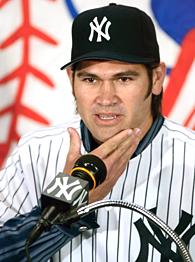
Fighting Words Q&A: Johnny Damon

"Damon! Shave those sideburns!" Photo from this site.

One of the highest compliments I’ll offer a ballplayer is to say he’d be a nice guy if he was pushing papers—or, heaven forbid, covering sports—somewhere. That’s not to say most guys are jerks, rather, that sportswriters get such limited access to players that it’s tough to get an authentic read on their personalities.

They’re pretty well-trained to be polite and cordial in their interactions with us, so you don’t want to be That Guy who walks away from a three-minute conversation gushing about how Player X is an awesome guy with whom you have so much in common.

Conversely, like anyone else, they have bad days where they are in terrible moods, so just like you don’t want someone to judge your personality the day your computer has crashed and forced you to spend six hours talking to Dell’s “customer service,” you don’t want to judge someone after he’s just gone 0-for-6, blown a key save or gone through some stuff away from the ballpark.

And some people who might be kindly and familial in the privacy of their own home just don’t like talking about themselves or are suspicious and/or unsure about the media in general, so it’s not fair to assume they’re bad guys when they give little or no time to reporters. Some of the best people I know would be horrible, horrible interviews. If my Dad was a ballplayer, he would have made Eddie Murray look loquacious, I am sure of it.

But two years covering Johnny Damon makes me pretty confident that he’s a nice guy by any standard. I never saw him turn away an interview request and never saw him lose his cool, even when he was being asked tiresome questions about his hair every single day in 2004 and 2005.

He also treated everyone the same regardless of experience or affiliation. My favorite Damon story occurred during the summer of 2005, when I assigned a Damon story to a young writer who was making his first trip to Fenway. He introduced himself to Damon, who said he’d be glad to talk after batting practice.

Ninety or so minutes later, the writer and I are in the locker room when Damon walks in. He goes to his locker, puts a few things away and begins scanning the clubhouse. I saw someone ask him what he was doing and he said he was looking for a reporter to whom he was supposed to talk. Unbelievable.

Damon discussed his role as a team spokesman type in Boston as well as provides a glimpse at why he was so patient and generous with his time in this interview, conducted in May 2006 at Yankee Stadium after Damon cut his hair and joined the Yankees as a free agent. It was the second interview we did for Fighting Words; the first was in the summer of 2004. Hope you enjoy:


How would you summarize the 2005 season?

I know I went in expecting to win another World Series and I think everybody thought we would too. But nobody realized that we ran into some major injuries—Schilling and Foulke—so that kind of dropped us down a little bit. And then signing a guy like Renteria was a huge boost for us, but losing Cabrera was pretty devastating too. We also went into the season without two of our starters that were there [in 2004], so it was a new feeling of guys that never played in a big market all of a sudden had to and had to help defend a world championship. There were lots of ups and downs, but we got back to the playoffs and we gave ourselves a chance. But no one had a chance against the White Sox last year.

How about the coverage of the Red Sox? How did it change after they won the World Series?

I think they were less reactionary. I think they kind of understood that the team’s nonchalant attitude—we lose and we’re just well, we’ll be al right—that’s how our team always approached stuff. We knew it was just a matter of time and it was a long season and all the players knew that. And I think we helped the media understand that it’s not as life or death as it may have been.

How important was it to have guys like yourself and Kevin Millar to absorb the media attention?

I think it was very important, because I think Boston could really tear up a player—Boston, New York. But if you have players all going in the same direction, it makes it a lot easier, because we had each other’s backs. If somebody made a mistake that cost us the game, we blamed it on the whole team. And I think certain guys understood that and liked it, just because there was a lot of pressure. Every opportunity I had, it was always my fault, and not because it was, but because I can deal with it. I can deal with people saying ‘Oh Damon, it was his fault.’ I can deal with it.

How different is the media here in New York?

I learned so much about being in Boston about the media that it’s been an easy transition for me. Obviously, I need to go out and do well. That and the way I play—the way I hustle—I think you win over fans right away. But you do have to continue to hit, you do have to continue to produce and win.

Are there more guys here to handle the media overflow?

Well, you’ve got six or seven potential Hall of Famers here, a lot of superstars. And there’s always a story. Boston, you have the same thing, but you might have one, definitely two or three Hall of Famers. The New York media knows that if they want a story after the game, you’ve got to go to the person who did something in the game or they’ll be gone and they don’t have a story. So it’s been easy. I come back to my locker sometimes thinking ‘OK, I’m here, let’s talk’ and [nobody is there].

That wasn’t the case in Boston, where you talked after every game no matter what you did or didn’t do.

Right, right. And not by choice. But I just remember walking in there [in 2002], how everybody just ran away and always put the blame on something else instead of themselves. I was one of the first ones—or maybe the first one [to act differently]. There’s no reason for them not to stick it on themselves. But a lot of players can’t admit that, and that’s too bad.

Why are you so comfortable dealing with the media?

I just don’t hide from the truth. The stats don’t lie, the scoreboards don’t lie. You can always look and say I struck out with the bases loaded [or] I came through with a bit hit. That stuff, you know? As long as it stays within the realm of baseball, it’s easy to talk about.

How much of that is your upbringing?

My parents taught me well and just taught me how to respect everybody. That’s a very important thing. I’m running into people nowadays who, because of the way I dress—I go into a clothing store or a jewelry store and they just don’t want to deal with me. It’s unfortunate people, with their stereotypes. It’s happened to me, and not only recently. Long hair [and] short hair.

Email Jerry at jbeach73@gmail.com.