Monday, August 17, 2009
Shaughnessy interview still to come...
Just a quick note here to apologize for not having the Dan Shaughnessy interview up yet. We had a weekend full of travel snafus and didn't arrive back at the home base until after midnight, so some recharging of the batteries was essential. We'll be back with the interview sometime today or, more likely, first thing in the morning. Thanks for your patience.

Friday, August 14, 2009
Bits and Bytes: My junior high orientation was never quite like this...
This is related to baseball in only the thinnest of ways, but here goes: The Red Sox just sent along what may be the most entertaining press release in the history of the written word. It touts the Red Sox Foundation hosting a city-wide middle school orientation Fenway Park Sunday, and if that’s not enough to make you wish you were 11 or 12 again, well, then you have no soul.
Not saying I’m jealous or anything, but I’m pretty sure my junior high orientation in 1985 occurred not at Fenway Park (of course, given I grew up two hours away from Boston, hosting orientation there would have been rather expensive and senseless) but during the spring of my sixth-grade year. That’s right, I’m so old that back in my day, junior high began in seventh grade. And we liked it!
A guidance counselor from the junior high came in to tell us how it was time to grow up because we’d have a lot more homework, would have to read stuff more challenging than Judy Blume and would no longer have recess. I can still remember the sinking feeling I got upon realizing I would no longer be among the last kids picked for kickball, softball and any other sort of athletic activity that required, you know, athleticism. (Of course we never picked teams for running laps around the playground. That, as the son of a marathon runner, was one thing I could do reasonably well) Childhood came to a screeching halt that day. Thanks a lot, random guidance counselor!
That these kids get to hang out with Wally at the lyrical bandbox isn’t what jumped out at me, though. I hate online acronyms, but this part of the release had me ROTFLMAO:
“The middle school years can be challenging for children and their parents, given the many changes that take place for children, both in terms of new schools and increased academic demands, as well as the social, emotional and physical changes that occur at this age.”
That’s a pretty long way of saying when it’s time to CHANGE, you’ve got to reARRANGE!
Here’s a couple other news items completely unrelated to puberty:
—While reading about middle school orientation at Fenway Park made me feel old, I’m not nearly old enough so that my declarations that Player X is the best I’ve ever seen at something should carry a whole lot of weight. So take this for what it’s worth: Alex Gonzalez, whom the Sox re-acquired today from the Reds, played the best shortstop I have ever seen during his previous stint with the Sox in 2006. The Sox posted the best fielding percentage in major league history that season, anchored in no small part by Gonzalez, whose .985 fielding percentage led AL shortstops and was the best in Sox history by a shortstop.
I covered the Mets during the Rey Ordonez years, including 1999, when he was part of what Sports Illustrated called the greatest infield defense ever. And while Ordonez was magnificent, he also had a knack for turning the routine into an adventure. Gonzalez made every play and never went into mail-it-in mode.
“[Mike] Lowell told me in spring training: ‘You’re going to see this guy do something about once a week that you’ve never seen before,’” Terry Francona said at the end of the 2006 season. “And that was not an exaggeration…he did some things that were unbelievable. He did some things that didn’t even look that acrobatic. Because he’s so good, after the play, [you say] ‘how the hell did he do that?’”
Unfortunately for Gonzalez, his defensive brilliance kind of got lost in the debris of a wrecked season. The Sox finished third, rendering their historic performance on defense somewhat meaningless. Gonzalez didn’t hit a whole lot, as is his career norm, and finished the year by hitting .182 in his final 82 at-bats and missing a considerable amount of time due to an oblique injury and a family emergency.
A spate of injuries—Gonzalez missed all of last season with a fractured left knee and has battled hamstring, oblique and elbow ailments this year—has reduced his effectiveness in the field to the point where it’s uncertain if the Gonzalez of ’09 is even an upgrade over utilityman Nick Green. Gonzalez will need to rediscover his defensive form of three years ago in order to really improve the Sox, since his offense has declined to rock bottom levels: He’s hitting .210 with a .258 on-base percentage and 15 extra-base hits in 243 at-bats.
Still, with the Reds actually paying some of Gonzalez’ remaining salary and the Sox only having to give up minor league infielder Kris Negron—who has yet to advance beyond Single-A after almost four years in the chain—it was well worth it for the Sox to take the gamble that Gonzalez has some magic left in his glove. I’d tune in this weekend, just in case.
—From the “egads, man, what are they thinking” department comes this: The Orioles expect to go to a six-man rotation in September in order to limit the innings of their young starters. Don’t they know the bad juju generated by such plans? I do wonder, though, if there’s some Orioles blogger salivating at the possibility of the six-man rotation and firing off thousands of words on the possibilities.
Email Jerry at jbeach73@gmail.com or follow him on Twitter at http://twitter.com/jerrybeach.
Thursday, August 13, 2009
When it comes to Lowell, the leader is still good
 Mike Lowell cemented his reputation as the Sox' leader with this takedown of Robinson Cano in 2007. Photo from this site.
From November through March, it’s easy to view the baseball season as a six-month marathon, one in which all clichés about a steady hand, calm approach and the eventual evening out of all statistical quirks apply. But it’s funny how easily those philosophies can be forgotten from April through October, when one-sixtieth or so of the season can feel like such a defining stretch.
And so it is that the Red Sox, perceived to be in full-blown sky-is-falling mode after a four-game sweep at the hands of the Yankees, are no longer in critical condition after three straight wins against the Tigers—each one easier than the last—and three straight losses by the Rays. Now it’s the Rays who appear unlikely to get off the canvas and the Sox who will be atop the wild card standings heading into this weekend’s series with the Rangers, who appear to be the second of the AL’s two serious wild card contenders.
That said, if the Sox do end up making the playoffs, they’ll likely look back on this single series as a defining moment, and only tangentially because Kevin Youkilis channeled his inner Twisted Sister by charging the mound against the Tigers’ Rick Porcello Tuesday (Joe Girardi expected something to happen and it did). Youkilis’ ejection and subsequent five-game suspension forced Mike Lowell into the lineup. Lowell is 5-for-7 with three homers and five RBI since he had to replace Youkilis in the second inning Tuesday.
Lowell is far from the only player contributing to this mini-resurgence. Jason Bay is back from a three-month sabbatical and Josh Beckett is pitching like a Cy Young Award winner and leading a pitching staff that has regained its effectiveness at just the right time.
But neither Bay nor Beckett is in the process of being marginalized by the Sox. Maybe I’m missing something 240 miles to the southwest (wouldn’t be the first time), but I don’t understand why the Sox seem so eager to reduce Lowell’s role.
I get that the Sox couldn’t pass up acquiring Victor Martinez for Justin Masterson and prospects and that Lowell’s hip problems make him the most obvious candidate to sit even on nights when Martinez catches. But still: There’s a special intangible quality to Lowell, an uncanny knack he has for being in the center of it all whenever good things happen to the Sox.
He won the 2007 World Series MVP, but I think Lowell’s defining moment occurred several months earlier in the aftermath of another Youkilis plunking. Less than 24 hours after Scott Proctor tried taking off Youkilis’ head in the ninth inning of a blowout Yankees win, Lowell had three hits and four RBI and broke up a potential double play by leveling Robinson Cano in between first and second base to lead the Sox to a come-from-behind 11-6 win.
The takeout of Cano was perfect: Laced with an undercurrent of anger and retribution, yet perfectly defensible given the situation. Without saying a word, Lowell stood up to the Yankees and declared the Sox would not be bullied. It’s impossible to measure how that sentiment helped the Sox over the rest of the season, but given the Sox held off the scorching Yankees for the AL East crown and came back from a three games to one deficit to beat the Indians in the ALCS, I’m willing to say he set a pretty definitive tone that afternoon.
There’s no teaching that and no developing that kind of leadership quality, but when a team has a player like that in its midst, it should do whatever it can to feature him, It’d be an entirely different story if Lowell was the veteran leader hitting .185, but he’s hitting .393 since coming back from the disabled list and he has 38 extra-base hits in 327 at-bats overall.
Sure, he’s far better at home (.324 with 26 extra-base hits and 39 RBI in 145 at-bats) than on the road (.286 with 12 extra-base hits and 20 RBI in 182 at-bats), and sure, it’s smart not to throw him out there seven days a week considering how he broke down in hitting .207 in June. But the Sox will have a lot better chance of going deep into October—and it’s sure fair to wonder how far they would have gotten last year if Lowell hadn’t been sidelined after the ALDS due to his bad hip—if Lowell is more than a role player. Maybe Lowell ripping it up over one-sixtieth of the season this week will convince the Sox of that, too.
Email Jerry at jbeach73@gmail.com or follow him on Twitter at http://twitter.com/jerrybeach.
Wednesday, August 12, 2009
Fighting Words Q&A: Pedro Martinez
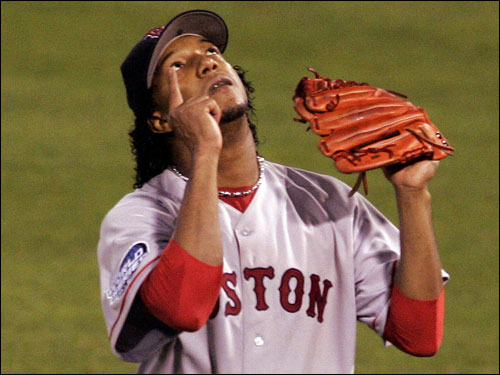
 Pedro Martinez is pretty interesting off the mound, too. Photo from this site.
As spring turned into summer and Pedro Martinez remained unsigned, I began to think there wouldn’t be a natural opportunity to post the Martinez interview I conducted for Fighting Words. Fortunately, Martinez signed with the Phillies during the All-Star Break and makes his debut tonight against the Cubs, so I am quite pleased this morning to unveil what ranks as perhaps the most memorable interview in which I've ever participated.
I could have written a book off of and about this interview alone. The Cliffs Notes version goes something like this: I traveled to Port St. Lucie at the beginning of spring training in 2005, months after Martinez left the Red Sox for a four-year deal with the Mets, with no idea if Martinez would be willing to talk about his fascinating relationship with the media in Boston but knowing it was essential to make the attempt.
Fortunately, on my first day in Port St. Lucie, I was among a group of reporters with whom Martinez was casually chatting. He started talking about how he’ll sometimes exhibit less control during his first run through a batting order so that he can set the opponent up for the middle and later innings. I said that sounded like something he’d done in a start against the Mariners in 2004 and he smiled and remembered the game to which I was referring. As the group dispersed, I hung back, introduced myself to Martinez and told him what I was doing and that I’d love to talk to him for the project. He said he’d talk to me late the next day.
Martinez kept his word, despite a distraction-filled day highlighted by a Mets employee who tried numerous times to sabotage the interview, and provided 25 incredible minutes in which he was equal parts brilliant, prideful and insightful about his career and his relationship with and observations of the press. I only used a fraction of what he said, but every word was interesting.
Enough out of me. Hope you enjoy this—I really think this will be worth your time. Sometime soon—I’m thinking Monday since I’ll be away for the weekend—I’ll have the Dan Shaughnessy interview in which I ask him about his relationship with Martinez.
What was it like going from Montreal to Boston?
Different. It was different. Montreal was very easygoing, very quiet. Very friendly. You will hear very little knowledge. And then, if you flip-flop that, you can hear everything else in Boston. I’m not saying anything bad, but it was so fast compared to Montreal.
How did you help out Orlando Cabrera when he was acquired from the Expos by the Red Sox last year?
He was lucky. He had people like me and Manny to protect him and keep some of the media members away from him. Because if you make a habit of giving them time whenever they ask, you will never work. And the same thing happens here in New York, as far as I can see so far. You just have to choose the time and the right time for you and for them [to] actually give them time, because the attention is always going to be there.
You weren’t seen a lot in the locker room last year…
I have a long regiment of work and it takes a lot of time. But my locker was also in the back. I had another locker in the back. I was always in the back room and that’s why you guys didn’t see me.
Do you think it’s part of your job to talk to the media?
Yes. It is part of my job. But I hate it. I hate it. I hate it. But I understand it’s part of my job.
You went several months without speaking to the press in 2003. What happened?
Yeah, there were a few things, some lies that flew, some things that were said out of, I guess, jealousy from some of the media members. Speculation and stuff like that. I don’t know really the reason, but they were very unfair and I didn’t feel like I needed to be treated that way after I had helped so many members of the media and been so helpful to them. Because I understand, as much as it is a part of my job to speak to the media, I understand that that’s their job, to make me talk and get some quotes. And I was always there to do that. And I can tell you some names that I believe were really, really good persons and gentlemen and good reporters as well. I cannot tell you everyone was the same though. But I must tell you, there were a lot of things that happened.
There are some good reporters in Boston, very good gentlemen. As much as I had bad people sometimes chase me around, the same way those people stood up for me. I remember Sean McAdam, Tony Massarotti, Michael Silverman, Bob Hohler. I remember Joe Castiglione. People like that, those were excellent people and those are the people that made my life easier in those seven years in Boston, because those people know me. They were good reporters and wrote what they saw, good or bad, but also were people that respect the game and the players and their personal lives and everything.
And that’s one thing I must tell you about the Boston media: They did respect our private life, especially mine. They were very, very professional about that.
What happened in Toronto in April 2003 when you talked about the Red Sox exercising your contract option?
I said I’m really happy and thankful that the Red Sox chose to pick up my option and kept the doors open for further negotiations. And somebody took it out of context and wrote it the way they wanted and said ‘Well, Pedro’s not happy with the fact that they picked up his option and he expects them to sign him to another extension.’ I never said that. I never mentioned that. I never mentioned that I wasn’t happy. I always said I was happy and I was very thankful. I don’t know what I said wrong there. Those were my exact words. And I remember Sean McAdam standing up and saying ‘This is exactly what he said and everybody has written it.’ But they called me greedy. I didn’t like that because it was never in my mind, it was never in my heart. We kept the doors open to further negotiations and we did negotiate in spring training [2004]. We negotiated all the way.
Why do you think Boston athletes often leave the city on bad terms?
I know Ted Williams was one person that hated to go to Boston because of the way he was treated by the media. Mo Vaughn left mostly because of that. Nomar wasn’t really happy when he left because of the treatment that they were giving him. And people like Shaughnessy, they keep on giving him the power of the pen without holding accountable for anything that he writes. I thought he was totally personal against Nomar. What he wrote after the trade, I didn’t think he was professional, what he did. And I don’t agree with it. And the same way I’m being treated right now by him.
It’s not all of them. I gave you some good names, good people, and there’s a lot more people that deserve respect over there. But there are some others that really don’t have my respect whatsoever.
What did you think about the coverage of your arrivals to spring training as well as your departures for and return from the All-Star Break?
The thing is I’ve always been very private with the way I do things. Things that are important to the media, I don’t need to relay to them. And sometimes they felt like I probably didn’t tell them enough and I guess they wanted to know every time I went out to eat or had a beer or something. I don’t think that has anything to do with baseball.
I was so upset [at the beginning of] last year [2004]. I was in a hospital in a room watching through the TV on the monitors and people [are] speculating about me being in a party. I was in the toughest situation I’ve probably ever been in. I’m not gonna go into details why, but that was probably the worst moment in my life. It wasn’t because I wanted to be there or because I wanted one more day away from spring training. It was because I couldn’t [leave]. And I would never do it, and I would have never gone to spring training until that problem was taken care of. I didn’t like it and I’m not going to like it. I will never hold a grudge, but I just think it was so unfair. A lot of those comments that came before were out of ignorance because people didn’t know. They didn’t know. They just wrote it in the papers and they knew they could sell papers.
Another thing—and I know it belongs to the Boston Red Sox—that WEEI radio station, it’s a station that’s there to just rip apart players. Those guys are, pardon me the word, [jerks], those two guys on WEEI. That station is 24 hours. And I know Curt Schilling has gotten on them a few times, called them up and stuff like that. That is something I never did, but I can really relate to some of the things and some of the frustrations that some of the players [had]. I ended up not reading the papers and not ever listening to them, but when my family has to call from the Dominican and say ‘This is what’s happening and this is on the Internet, people are saying this and I thought you were in Boston in the hospital and they’re saying that you’re here in the party.’ When my mom calls from the farm and says that, it really pisses me off. That’s different.
How did you end up as the spokesperson for Manny Ramirez for a few years?
I was the one that would get a quote from Manny to try to help them out. I did it more for the guys that really deserved it, like those guys I mentioned, guys that were gentlemen, because there were some bad ones that were out there. Manny would not speak to any of them, so I had to go and get quotes. Sometimes I bring [quotes from] Urbina, Urbina never talks either. So I go and get quotes and help them out. But those are things they would never write about or specify—‘Pedro was the one trying to help us out.’
Did you have anything to do with Manny’s more talkative demeanor last year? And why did he change?
A lot, a lot. Manny, at first when he saw what it was like in Boston, he sometimes felt uncomfortable. But I told him ‘You still have five more years to go, you might as well just settle down and understand this is going to be the way it’s going to be.’
Why did you decide to speak after games last year?
Because of those good people [in the press]. Once they opened the media room, where they could all go there and ask their questions one by one, I didn’t see why not. I could really be responsible for what I had to say. I talked Manny into being a little bit more helpful and I have to lead by example, so I was trying to do as much as I could. I decided to speak [after] every game, but not do it in between my workouts, the days I was working out. So I tried not to miss any interview [room sessions], and if I did, I would leave a quote.
Did you ever feel as if people were trying to get you to say something inflammatory whenever the Red Sox played the Yankees?
Yeah, because I made news. When you have a star player like me or Jeter or somebody like that, they want to make everything more interesting than it is. And Jeter goes about his business, Bernie and those guys are very professional, and I am the same way. But they wanted to set something up before we got there, they wanted to touch a trigger where somebody could get pissed off and say something. And I can understand that. If you didn’t get personal, it didn’t matter.
You made a lot of back pages in New York…
They wrote about the man. [The New York Post] wrote ‘The man New York loves to hate.’ Nobody knows the man. People know the player. It didn’t offend me, I just wanted [reporters] to understand that the man is a different thing that the player New York loves to hate the most. That would be a totally different phrase than the man New York loves to hate. The man—nobody knows, very few people know him. I’m a totally different human being once I take my uniform off. Even if I’m in uniform and I’m not competing, I’m totally different.
Did you sense the relationship between the Sox and the media was more tense when the Yankees were a topic?
Boston is so small—so many members of the media, so much competitiveness between the reporters that they sometimes have to speculate or say something negative or something to be in the spotlight. I don’t blame them, because there’s so much competition between them. It has to come out somehow. Most of the time, the good guys are ignored in Boston. Sometimes their quotes, when they write it the way that we say it, they don’t run it. They run the quotes where we snap and say whatever.
Along those lines, were you upset with the attention you received for the “daddy” quote?
See, that’s what I’m talking about. If anybody thought that my mind or my approach to the game changed because of that, it’s totally wrong. The thing is, it was a good quote, so people loved it. Now, what I said when I was in New York one time and I pitched a great game and everybody was yelling and screaming, I said I feel so lucky, but nobody plays that one. I feel so lucky because they took me out of a mango tree and made me a center of attention. They gave me so much respect by just putting all of their attention to me, to one single man. I used to be under a mango tree and they didn’t pay attention to that one. But “The Yankees are my daddy”—that was a great one. Pretty big. That was a pretty big one.
Do you think people misunderstood what you meant with that quote?
I was just frustrated and I said that out of anger, for doing my job and still not winning. And you know what, the Yankees can’t say they’re my daddy either, because if you take the box scores—like they say, it’s pretty even. No one remembers anything positive. It seems like the good things will never get the chance. That can tell you who’s evil and who’s not. Whoever writes the right things, whoever writes it the way it is, is the one that’s thinking more like a person, like a person that understands good and bad. But the ones that only write ‘Oh, Pedro hasn’t beaten the Yankees in, what, five outings’—only ones whose negativity comes out. I might not beat the Yankees, but the Yankees haven’t beaten me either.
(Note: Martinez went 10-10 with a 3.20 ERA and a 1.08 WHIP in 28 regular season starts for the Sox against the Yankees)
Now that the Red Sox have won the World Series, how do you think the relationship between the Sox and the media will change?
What I wondered is what is the media going to write about? Because all they wrote was negative—not all of them, like I said before. But the people that really wanted to write negative now they don’t have anything to complain about. I’m wondering what are they going to complain about now? Now they’ve got a championship from the Red Sox, another one from the Patriots. Now we need the Celtics to win. That might be the next complaint.
Did you ever talk to Ted Williams about his relationship with the press?
No, I did not. I never spoke to him about anything else other than baseball and pitching. He asked me a couple of questions, I answered. He gave me a great compliment by saying that I was one of the best pitchers he had ever seen and signing a program for me. That I will never forget and [will] keep forever.
Did the Sox want to win in spite of the media, to prove it wrong?
That was our mentality. We knew from spring training. We were always holding a meeting. We will always tell the rookies: ‘If you don’t know what you’re going to say, you better not say it, because they make everything big out of everything we say.’ So you were better off not saying anything if you were a rookie. And we knew that we were fighting an uphill battle with the media, regardless of how good we did. If we were in first place in June, they were going to say ‘Oh, in July, they’re gonna die.’ If we made it to the playoffs, ‘they’re gonna go [out] in the first round.’ And that’s how they always felt.
Email Jerry at jbeach73@gmail.com.
Tuesday, August 11, 2009
It ends in dust and disarray
There’s something universal about being told your services are no longer needed, even when the discarded employee is a Hall of Fame-bound pitcher with a nine-figure bank account. And so it was John Smoltz who last week provided the latest reminder that professional athletes are never as compelling as when they are in the twilight of their careers, when they come to realize a burning passion for the craft is no longer enough when they are at the mercy of factors beyond their control.
Smoltz’ resume and legendary competitiveness convinced the Red Sox he was going to come back from major shoulder surgery and contribute as a 42-year-old, but he was designated for assignment last Friday, less than 24 hours after he gave up eight runs in 3 1/3 innings against the Yankees. At least Smoltz was let down somewhat gently by Sox management, which gave Smoltz the conflicted “it’s not you, it’s us” treatment.
The coldly corporate bloodletting Friday was left to the Athletics, who released Jason Giambi hours before the Sox cut Smoltz. In the press release announcing the transaction, the Athletics made sure to point out that Giambi had the lowest batting average in the bigs and the American League’s fourth-lowest slugging percentage when he went on the disabled list in July. Presumably, the only reason the A’s didn’t mention Giambi’s bad breath is because there’s no statistical measure of halitosis. Stay classy, Billy Beane.
Smoltz’ dismissal was also far smoother than the one executed by the Braves June 3, when they released 300-game winner Tom Glavine—Smoltz’ longtime teammate and friend—just as he was ready to return to the Braves after rehabbing elbow and shoulder injuries.
But no matter the delivery, the message and the lesson is always the same. Regardless of how good a player is or was, he almost certainly will not have the chance to dictate how he exits the stage. For every player who walks off in triumphant fashion—John Elway, Barry Sanders, Mike Mussina—there are thousands, from mere mortals to iconic superstars, who have the decision made for them.
The player almost always disagrees with the decision, as he should. The self-confidence that makes these athletes the best in the world disappears long after their bat speed, fastball, arm strength or foot speed. There’s always something else to try or an adjustment to make that will allow a player to leave on his terms, even if he admits he can’t quite identify what those terms would be.
Presuming Curt Schilling does not re-scratch that itch, he’ll always be able to say he won a World Series game in his final big league appearance. Pretty awesome, yet not at all how he would have scripted it. Schilling signed a one-year deal with the Sox shortly after the 2007 World Series and spent several months in 2008 trying to rehabilitate his wrecked shoulder before he finally underwent another surgery, after which he worked out for a few more months in hopes of returning in 2009 before he finally retired in March, his ending penned for and not by him.
“We’re always wired to think that we can find a way—I can still do this somehow, someway,” David Cone said in April 2003. “Part of that wiring is what drives great athletes, keeps them going. We’re supposed to think that way, almost unrealistically, at some juncture.”
Cone, who isn’t going to the Hall of Fame but had one of the most memorable careers ever in winning five World Series rings and throwing a perfect game, spoke days after he was placed on the disabled list due to an arthritic right hip. He came back in late May, made one relief appearance for a Mets team headed for 95 losses and realized he was done the next morning when he had a hard time walking to the bathroom because of the hip pain.
At 40, there was no way to top what he’d already accomplished, but Cone still wanted to pen his own ending, as unattainable as it seemed and until it was physically impossible to do so. “The bottom line with me is I’m no different than any other athlete at the end of his career, searching for a perfect ending that may not come,” Cone said a month earlier.
The final imperfect ending is rarely the first for a player. Many members of the 2004 Red Sox lamented management’s refusal to keep the team completely intact. Along those lines, the release of Smoltz is just the first of many awkward exits on the horizon for these Sox. The acquisition of Victor Martinez means the beginning of the end for Mike Lowell and Jason Varitek, two irreplaceable parts of the 2007 title team but a pair of players who no longer fit into the Sox’ long- or short-term plans.
Tim Wakefield is beloved inside and outside the clubhouse, but after four straight injury-plagued seasons, the Sox are, at some point soon, going to decide that they can no longer go forward with him, even at $4 million per season. David Ortiz built up a lifetime of good will from 2003 through 2006, but that credit only goes so far when the batting average is hovering just above the Mendoza Line and the reputation is in tatters.
Most of the time, the decision made by management is the right one. To try and recapture the 2004 championship magic with a team that had eight everyday players, four starting pitchers, a closer and two top set-up men all on the wrong side of 30 wasn’t the smart thing to do from a baseball perspective and would have delayed the retooling that resulted in the 2007 championship.
It’s also hard to argue with the recent moves made by the Sox, Athletics and Braves. Maybe Smoltz and Giambi can still contribute in smaller roles, but it didn’t do the contending Sox nor the rebuilding Athletics any good to continue sending them out there as regulars. And Tommy Hanson, the 22-year-old who took the spot in the rotation once reserved for Glavine, is 7-2 with a 3.05 ERA in 12 starts.
Still, that aging players usually lose their jobs because of the ultimate bottom line, not some random figure devised by a bean counter 3,000 miles away, makes their fates no less poignant. We don’t know what it’s like to stand on a mound or in the batter’s box, never mind throw a fastball 95 miles an hour, hit a baseball 400 feet or celebrate a world championship. But to have someone attempting to extinguish the fire that still rages inside? That—that we all know about.
Email Jerry at jbeach73@gmail.com.
Monday, August 10, 2009
Bits and Bytes: 8/10/09
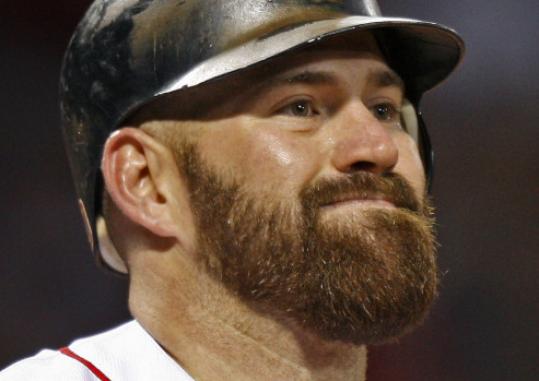
 Kevin Youkilis is grimacing about plenty these days. Photo from this site.
Sincere thanks to Jon Couture, who produces the so-good-it-makes-me-jealous Better Red Than Dead blog at SouthCoastToday.com, for penning a very complementary review of Fighting Words in his Sunday column in the New Bedford Standard-Times. As nice as it is to receive verbal boutiques from family and friends, it’s particularly humbling and invigorating to get such positive feedback from a journalist unrelated to me. Cooch, you’re on the Christmas card list!
Some other bits and bytes from my mini-vacation:
—When it comes to absorbing the media attention during times of crisis and generating a rallying cry for his teammates, Kevin Youkilis isn’t exactly evoking memories of Kevin Millar, as your good friend and mine Joe Haggerty details in this blog post from yesterday. It would be folly to read too much into Youkilis’ feistiness, as the 2007 Sox proved a team could not exactly welcome the attention bestowed upon it yet still block out all distractions—real and perceived—and win a championship, but it will be interesting to see (or hear) how the Sox and the press get along if the Sox continue to stumble.
—I don’t know about you, but I was stunned Tuesday night, when the Dodgers’ Guillermo Mota plunked the Brewers’ Prince Fielder with two outs in the ninth and the Dodgers clinging to a 17-4 lead. I mean, who has ever heard of a Joe Torre-led team sending a noted headhunter to the mound in the ninth inning of a blowout win to exact revenge for an earlier plunking (Manny Ramirez had been hit by a pitch by ex-Sox farmhand Chris Smith)? That’s crazy talk.
Afterward, Fielder channeled Mike Piazza by trying to barge into the Dodgers’ locker room and assault Mota. Ramirez was shockingly out of the lineup the next day, leading to this classic reaction from Brewers manager Ken Macha.
Torre, of course, expressed surprise and disgust at still being asked about the incident less than 24 hours later. Let’s give him credit though: He doesn’t seem to have blamed ESPN for it.
—Phillies GM Ruben Amaro is talking about going to a six-man rotation once Pedro Martinez is ready for big league action. And somewhere in Fenway Park, Theo Epstein laughs, because the only other alternative is to cry.
—Looks like our instincts were, for once, right. Indians president Paul Dolan met with the Cleveland media last week and wailed about how the Indians had to trade Cliff Lee and Victor Martinez because they’re hemorrhaging money—$16 million, to be exact, which just happens to be how much the Indians would have paid Lee and Martinez had the club exercised their options for next season. Funny how that works.
He also mentioned how difficult it is for the Indians to compete under baseball’s current financial system and how the club is unable to retain its own players once they get beyond their arbitration years. Of course, he wasn’t squawking two years ago, when the Indians were a win away from the World Series, nor over a nine-month span in 2007 and 2008 when he managed to find enough change in the cushions to lock up Travis Hafner, Jake Westbrook and Fausto Carmona to long-term deals. Those three will make more than $24 million this season, a pretty gaudy sum for a 32-year-old injury-prone DH, a pitcher unlikely to appear in the bigs as he recovers from Tommy John surgery and a hurler who was sent to rookie ball following an awful start.
Dolan also complained the small-market teams are unable to even compete for amateur players anymore. Mark our words: This is just the beginning of Dolan and other hawkish “small-market” owners doing the dirty work for Bud Selig as he aims to implement a salary cap and overhaul of the draft in the next labor agreement
Email Jerry at jbeach73@gmail.com.
Bleech to the Future
 A horrified Doc and Marty look back at the flaming wreckage of the 2009 Red Sox. Photo from this site.
First things first: My humble apologies for the unplanned absence. We had some actual paying work pop up last week, so that took precedence. Hopefully it’s a sign of things to come and forces me to better manage my time (ha!).
So on to the news of the week: Who invented time travel while I was gone and why did he/she subject the Red Sox to a trip back to the crappy late summer of 2006?
A season in which the Sox enjoyed a winning streak of more than 10 games and looked for lengthy periods of time to be the best team in the American League may have been flushed down the drain by the Yankees in a four-day span. The Sox were 69-50 and 1 ½ games out of first the morning of Aug. 18, 2006, the day they dropped a doubleheader to the Yankees to begin the five-game sweep and their second losing streak of at least five games since the All-Star Break. These Sox were 62-44 and 2 ½ games out of first as of Thursday morning and two losses into what is now their second losing streak of at least five games since the All-Star Break.
Like then, the soul-crushing defeat occurred during a Sunday night game in which the Sox’ co-ace threw seven strong innings before a young and hotly hyped fireballer suffered a multi-homer meltdown.
David Ortiz, who three years ago missed eight games with an irregular heartbeat, is once again holding a press conference, albeit three weeks earlier this time, in which many questions remain unanswered. Theo Epstein is emerging from the shadows—this time prior to the second game, not prior to the fourth—to discuss the challenges suddenly facing the Sox.
The Sox have been attacked by a litany of injuries, and with their left fielder and shortstop on the shelf, they have been forced to send Kevin Youkilis into the outfield and to rely much more than anticipated on their backup shortstop (Alex Cora then, Nick Green now).
The Sox’ starter in the series opener—Jason Johnson then, John Smoltz now, this marks the first time in history Jason Johnson and John Smoltz have been mentioned in the same sentence—was designated for assignment before the second game, symbolic of the sudden lack of pitching depth that is forcing Epstein to sign or acquire anyone with a pulse (Paul Byrd is essaying the role of Kevin Jarvis) and reshuffle the bottom of the staff on a daily basis.
Check out the transactions then and now:
2006:
Aug. 18: Activate Keith Foulke from DL, DFA Johnson
Aug. 19: Recall Jermaine Van Buren, DFA Rudy Seanez, option Van Buren
Aug. 20: Recall Javier Lopez
Aug. 21: Purchase contract of Bryan Corey, option Craig Hansen
2009:
Aug. 6: Place OF Rocco Baldelli on DL, recall OF Josh Reddick
Aug. 7: Claim IF Chris Woodward off waivers, recall Junichi Tazawa, DFA Billy Traber and John Smoltz
Aug. 8: Place SS Jed Lowrie on DL, recall Enrique Gonzalez
Aug. 9: Purchase contract of Fernando Cabrera, DFA Gonzalez
Despite the flurry of pitching-related transactions, though, the Sox’ problems have been at the plate (you may have heard about that 31-inning scoreless streak) and not on the mound, at least since Smoltz’ meltdown Thursday. The 2006 Sox were outscored 49-26 in the five-game sweep, including 47-25 over the first four games. The power outage began as the series against the Yankees ended: Starting with the fifth game against the Yankees, the Sox scored three or fewer runs in 15 of 17 games.
The 2006 Sox never recovered from the Boston Massacre II, going 17-21 thereafter and never threatening in the wild card race. And the temptation, as the Sox trailed 1-0 late Sunday, was to write that a sweep here wouldn’t be nearly as demoralizing as the sweep three years ago.
The Sox cannot possibly be as offensively inept as they looked over the weekend. They will need to be resourceful, certainly, because the 54-homer Ortiz is gone and never coming back and Manny Ramirez is not walking through that door. Ortiz is just one of several Sox regulars skirting perilously close to automatic out status along with J.D. Drew, Jason Varitek, Jason Bay (.221 since May 14) and Nick Green (.127 in his last 79 at-bats).
But Jacoby Ellsbury, Dustin Pedroia and Kevin Youkilis all began Sunday hitting at least .300. As eager as the Sox seem to be to put Mike Lowell out to pasture, he’s hitting .352 with 13 RBI in 54 at-bats and more walks (eight) than strikeouts (six) since he returned from the disabled list. Victor Martinez is hitting just .219 since May 17, but he was 10-for-21 in his first four games with the Sox and delivered the big hit last night, so perhaps a pennant race is all he needed to revive his season.
As tattered as the pitching staff is, Josh Beckett and Jon Lester still provide a far better and reliable 1-2 punch than Curt Schilling and Beckett three years ago. Clay Buchholz, Junichi Tazawa and Brad Penny offer more upside and potential than any of the castoffs the Sox had to send out to the mound in the final six weeks of 2006. Daniel Bard wore the goat horns Sunday, but on his worst day is nowhere near Craig Hansen.
And if this season has proved anything, it’s that Kevin Millar was right and this is a marathon not a sprint. It was foolish to declare (as I did) the Yankees finished when they lagged behind during the season’s first three months and dropped the first eight games against the Sox, and it’d be similarly risky to assume the Sox are finished now.
Even if they prove to be toast in the AL East, the Sox are still at the forefront of the wild card race—unlike three years ago, when the sweep by the Yankees left them four games behind the White Sox. Get to the playoffs and beat the Yankees in the ALCS and nobody at all will care about what happened in August, just as nobody at all now cares what happened in the first eight games between the teams.
But now…now I don’t know. To take the lead like the Sox did—with Martinez delivering a seismic, scoreless streak-busting, two-run homer—and then to lose it like they did—with Bard giving up the go-ahead homer to Mark Teixeira, whom the Sox supposedly pursued like crazy last winter and whom they could really use right now to anchor a lineup that doesn’t have a big-time power threat—is demoralizing.
It’s fair to wonder how long it will take the Sox to recover from Sunday’s loss, and the schedule does them no favors, not with the AL Central-leading Tigers and the wild card foe Rangers coming up this week to begin a season-ending stretch in which the Sox play 30 of their 52 games against teams currently within three games of a playoff spot.
The swiftness with which the Yankees have surged to the top of the AL East lends a certain finality and certainty to the division race and an additional layer of precariousness to the Sox’ situation. To see Lowell doubled up even after Derek Jeter had to pause in the middle of his throw to first base Saturday is to think the Sox look far older and over-the-hill than the Yankees did 15 weeks ago last night, when Ellsbury stole home off the Yankees’ aging battery of Andy Pettitte and Jorge Posada.
For crying out loud, even Joe Girardi—usually as slick as sand—has begun to develop the smugly arrogant Teflon air of Joe Torre. After Ramon Ramirez got tossed for hitting Alex Rodriguez in the eighth inning Saturday, Girardi said the Yankees “…expected something to happen and it did.” Gee, you think Joe? Couldn’t have anything to do with Mark Melancon trying to take off Pedroia’s head or the numerous times Yankees pitchers have hit Sox batters this year could it?
But hey, if Girardi wants to put his hands behind his back and passive-aggressively tsk-tsk the Sox for punching back, well, his team is 6 ½ games up in the standings. He can do that. The Sox have a lot more pressing things to worry about than Girardi’s behavior anyway and a lot of work to do to turn around a season that once seemed magical but is now threatening to turn sour. They can only hope Sunday—when 8-4 looked and felt so much worse than 0-8 ever did to the Yankees—is rock bottom and not just the beginning of the descent.
Email Jerry at jbeach73@gmail.com.
Subscribe to:
Posts (Atom)