Sure, history indicates the teams that execute blockbuster deals at the trading deadline aren’t the ones that win the World Series. But that doesn’t mean we can’t wonder why the Yankees didn’t land Roy Halladay last week.
Granted, if the likes of the Red Sox and Phillies couldn’t land Halladay because they wouldn’t part with the best of their farm system, then why would the Yankees? They’ve done a much better job of harvesting big leaguers than most of us give them credit for: Eleven players on the current 25-man roster were drafted and developed by the Yankees, and that total doesn’t count Alfredo Aceves and Brian Bruney, whom the Yankees picked up as minor league free agents.
But now that Phil Hughes and Joba Chamberlain are in the bigs, the Yankees’ system has reverted back to its familiarly empty state. Outfielder Austin Jackson and catcher Jesus Montero, the jewels of the chain, have star potential but are nowhere near finished products.
So the Yankees couldn’t provide anywhere near the package J.P. Ricciardi wanted for Halladay, but this still seemed like a perfect opportunity for the Yankees to flex their financial might and mimic the government by bailing out a desperate team. Never mind how badly the Yankees would seem to need Halladay to anchor a rotation that could be pretty thin by playoff time. As noted last week, there are no guarantees that a top three of Halladay, CC Sabathia and A.J. Burnett would be able to handle the playoff pressure, but I imagine the Yankees would feel better about their chances if the fading Andy Pettitte didn’t have to start one of the first three games of a five-game series.
Then again, the Yankees aren’t the only potential playoff team with a vulnerable looking rotation. All that time spent wondering how the Red Sox would fit eight starters into five spots looks pretty foolish now that the Sox are down to two reliable guys, Josh Beckett and Jon Lester.
Clay Buchholz did his best to make the Indians look good yesterday, when he didn’t stick around long enough to earn the win despite being staked to leads of 7-0 and 14-6. Such stunning ineffectiveness has become the norm for the other four candidates to earn a spot in the postseason rotation. Buchholz, Brad Penny, John Smoltz and Tim Wakefield are 5-6 with a 6.32 ERA since July 1. (I’ll believe Daisuke Matsuzaka makes another appearance in a Red Sox uniform when I see it)
The Angels’ rotation drops off drastically after Jered Weaver and John Lackey, as well, and it remains to be seen how the Rangers’ pitchers hold up over the final two months. All of which means that the scariest team in the playoff field might well be the one overlooked by most: The AL Central champ. The Tigers (Justin Verlander, Edwin Jackson and newly acquired Jarrod Washburn) and the White Sox (Mark Buehrle, Gavin Floyd and John Danks, plus maybe injured newcomer Jake Peavy) each have deep rotations fronted by playoff veterans.
Better to be in their position, certainly, than that of the Yankees and Red Sox, who look as if they’ll need some kind of catchy slogan to summarize the thinness of their postseason rotations. How’s “CC and A.J. and a few days of delays” sound?
Email Jerry at jbeach73@gmail.com.
Showing posts with label Roy Halladay. Show all posts
Showing posts with label Roy Halladay. Show all posts
Monday, August 3, 2009

Thursday, July 30, 2009
Repeat after me: Roy Halladay will get traded, but not to the Red Sox
 Acquiring a spare part like Brian Anderson might not leave Sox fans jumping for joy, but if history is any indication, they'll have to be satisfied with it anyway once the trading deadline arrives today. Photo from this site.
The Yankees are getting hotter and the Red Sox are getting colder (sorry, but needing a late comeback today to split a series with the Athletics, who stopped trying around March 31, does not reverse the post-All-Star Break slide) as the trade deadline approaches, so the first instinct is to say the Sox have to do something, anything, to keep up with the Yankees, especially with the Phillies no longer in the running for Roy Halladay.
And don’t let J.P. Ricciardi fool you: The Blue Jays will trade Halladay within the next 24 hours. I have no sources telling me that, or anything cool and juicy like that. But Ricciardi is like that owner in your fantasy league who tells everyone you better hurry up and make him an offer for his star player because he’s got big deals on the front burner, except he’s just bluffing like crazy in hopes someone actually believes him and overpays. When the rest of the league doesn’t panic and overpay and instead makes a more reasonable offer with someone else, Ricciardi—err, the owner in your fantasy league—is forced to dump his star for less than he would have liked.
Further complicating things for Ricciardi and the Jays is the fact Halladay’s trade value will never be higher than it is right at this moment. Just look at what the Rangers got for Mark Teixeira at the 2007 deadline, a year-and-a-half before he reached free agency, and what the Braves got for him last year
But when Halladay is traded, it won’t be to the Sox, even if they’ve gone from having way too much starting pitching to not enough over the last couple weeks. And it’s precisely because the Sox have stumbled badly this month and because they need Halladay that they won’t get him.
Oh sure, there have been plenty of rumors proclaiming the Sox the frontrunners for Halladay, and chairman Tom Werner told reporters in Cooperstown Sunday that Theo Epstein was “…burning the midnight oil” as the deadline approached. Of course, Werner also said the Sox didn’t want to part with any of their top prospects, which correlates with what John Henry Twittered following the Adam LaRoche trade.
Now is it possible the Sox are just bluffing when they declare off-limits the best of their young players? Of course. But to execute a midseason blockbuster—without an unhappy superstar forcing his way out of Boston in the process—would deviate drastically from Epstein’s m.o.
Again: The Sox are the only two-time champion in baseball this decade, run by a bulletproof general manager who stood pat three years ago, when the Sox were in first place and he had nowhere near the political capital he enjoys now. He maintained the status quo even though the Yankees were pursuing a difference-making bat, Bobby Abreu, whom they acquired for almost nothing.
The Yankees are probably the team most likely to land the prize of this trade deadline, as well, especially now with Chien-Ming Wang out for the season, NL castoff Sergio Mitre serving as their fifth starter and the suddenly surging Joba Chamberlain approaching his laughably secretive innings limit. Imagine how sturdy the Yankees would look in October with a top three of Halladay, CC Sabathia and A.J. Burnett.
But Epstein was willing to absorb the short-term hit to better position the Sox for long-term success in 2006. In addition, to trade for someone like Halladay would bolster the Sox in the short-term but also leave them with precious little young pitching depth. Beyond Clay Buchholz, Michael Bowden and Justin Masterson, the Sox don’t have any impact arms ready to move into the rotation. Junichi Tazawa was just promoted to Triple-A Pawtucket, but the rest of the Sox’ most promising pitchers are at Double-A or below. So what do the Sox do if injuries strike over the next 15 months?
That said, dealing prospects for an impact hitter would make more sense, since the Sox have bucked conventional wisdom by having more luck developing pitchers than hitters. But a deal for the Padres’ Adrian Gonzalez and/or the Indians’ Victor Martinez is a lot less risky in the winter than in July.
This already seems like a team headed for some kind of overhaul after the season. Lowell and Jason Varitek are playing less frequently. Jason Bay is playing himself right out of a long-term deal. J.D. Drew is, well, J.D. Drew. Daisuke Matsuzaka is complaining about how the Sox have treated him, which seems to be a fine way to assure that the Sox have to give the Edgar Renteria/Julio Lugo treatment to someone who doesn’t actually play shortstop. Tim Wakefield’s not going to make a start on his 43rd birthday. The Sox’ starting shortstop, whomever he is on a given day, still would not start for the majority of big league teams.
And that’s just the guys who don’t fit into the long-term plan. David Ortiz learned this week that hitting .220 may be the least of his problems. Kevin Youkilis is hitting .251 since returning from the disabled list May 20.
Most notably, Jonathan Papelbon is allergic to the 1-2-3 inning, and Jon Couture made a pretty good case Wednesday why Papelbon may not even be among the top tier of closers anymore. For all his talk about wanting to inherit the title of best closer in baseball from Mariano Rivera, Papelbon has never seemed the type to remain durable or dominant well into his 30s. What if we’ve already seen the best of Papelbon and this recent ineffectiveness is the beginning of the end? Why would the Sox deal potential heir apparent Daniel Bard for Halladay?
A lot of difficult decisions will have to be made after the season. Why begin the process in midseason and try to make all the new pieces fit on the fly—and, perhaps in the process, further reduce the playing time of the captain and his unofficial first lieutenant—instead of during six or seven weeks in Ft. Myers? Especially when the diluted nature of the AL means even the flawed Sox, who still lead the wild card race, can still make quite a run at the AL pennant or beyond?
Assuming the current division leaders all hang on, the Sox would face the Angels in the AL Division Series, which, even in the Sox’ weakened state, is like earning a bye into the AL Championship Series. Figure the Yankees beat the Tigers, even if the decidedly underdog Tigers crushed the Yankees in the 2006 ALDS and the Yankees haven’t moved beyond the first round since 2004.
In the ALCS, would you want to bet against the playoff-hardened Sox—led by the 1-2 punch of Josh Beckett and Jon Lester atop the rotation—figuring out a way to beat the Yankees, even if they did field a rotation of Halladay-Sabathia-Burnett? That’s two ex-Blue Jays who have never made a postseason start and Sabathia, who has recorded an ERA of 9.47 the last two Octobers and is 0-2 with a 5.66 ERA against the Sox and Rays this season.
For all the internal reasons why it behooves the Sox to stand pat, none is as convincing as an external one: History indicates the teams that make the biggest moves at the trade deadline are not the ones that win the World Series. (More on that tomorrow)
More than two-thirds of the way into the season, a team—to borrow the most tired phrase of the decade—is what it is. Whomever is going to win the World Series is going to do it with a core it has been establishing since April, not players it’s adding this month. So as fun as it is to wonder how good the Sox would be with Halladay, Gonzalez or Martinez, the most exciting thing to happen today will probably involve adding another former big leaguer to Pawtucket’s outfield.
Email Jerry at jbeach73@gmail.com.
Thursday, July 23, 2009
Wednesday's deals are probably the main dish, not the appetizer
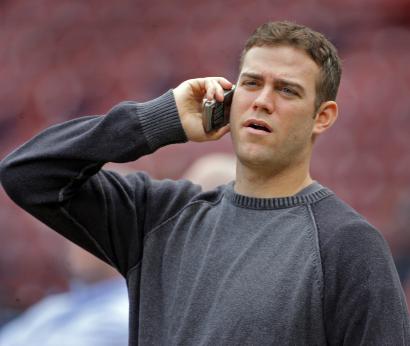
 Theo from Brookline will spend plenty of time on the phone this month, but don't expect a blockbuster. Photo from this site.
Given that I was the guy who predicted Tuesday the Red Sox would not be tied for first place for long (positive spin: I was half right!), I probably shouldn’t be making any grandiose predictions for the rest of the week. But I will once again ignore common sense and type the following sentence anyway:
The trades the Sox made Wednesday are not the appetizer for a blockbuster involving Roy Halladay or anybody else.
That’s not to say the Sox are done dealing after acquiring Andy LaRoche and Chris Duncan, or that they won’t be linked to the big names between now and next Friday. Theo Epstein told reporters Wednesday he hopes to make at least another move and that the Sox are interested in players who can provide a “…significant impact on the roster.”
But Epstein’s history—and in particular his activity at the 2005 and 2006 trading deadline—suggests the Sox will tinker with instead of overhauling the big league club, even if the Sox (who lost their fifth straight game Wednesday to fall two games behind the scorching Yankees) look as if they’re in dire need of some help, especially on offense.
Like they were in 2005 and 2006, the Sox are stuck in some kind of baseball purgatory. They are neither the clear favorite to win the World Series nor one player away from earning that moniker. Yet even if the Sox were a “one player away” team, they probably wouldn’t part with a top prospect to get him, anyway.
Epstein has never made a mid-season trade that forced him to part with one or more of the Sox’ better prospects. He traded Freddy Sanchez to the Pirates in July 2003, but Sanchez was already 25 and did not emerge as a regular for the Pirates until two years later. He won the NL batting crown in 2006, but the Sox did pretty well in finding their own future second baseman: Dustin Pedroia won the Rookie of the Year in 2007 and the MVP in 2008.
Come to think of it, Epstein hasn’t made a winter trade in which he gave up the best of the farm, either: He was on sabbatical when the Sox dealt Hanley Ramirez to the Marlins in the Josh Beckett/Mike Lowell deal.
And if Epstein had the guts to stand pat in 2006—when he was a few months removed from his dramatic return to the general manager’s office, the Sox still led a very winnable division despite a July swoon and the Phillies willing to give Bobby Abreu to anyone willing to take on the rest of his contract—then he surely won’t be swayed by popular opinion this year, not with another World Series ring on his finger and a fruitful farm system as ready to begin harvesting position players now as it was ready to begin graduating impact pitchers then.
Lars Anderson, Josh Reddick and Ryan Kalish aren’t likely to arrive as fast or as resoundingly as Clay Buchholz, Jon Lester, Justin Masterson and Daniel Bard have over the last two seasons, but the trio of position players—all of whom are currently at Double-A Portland—are still on pace to get to the majors by sometime in 2011. Come 2012, the Sox could have at least six homegrown regulars (Anderson at first base, Dustin Pedroia at second base, Kevin Youkilis at third base, Jacoby Ellsbury in left field, Reddick in center and Kalish in right), which would allow Epstein to spend the big money on a designated hitter to replace David Ortiz as well as at catcher and shortstop, two familiar problem areas for the Sox.
Yet, just like in 2005 and 2006, the Sox’ recent subpar play and the loaded nature of the American League demands Epstein do something to keep up with the Yankees as well as wild card contenders such as the Rangers and the Rays. And that “something” will almost surely once again involve mining the cutout bins in hopes of finding someone who can provide a boost at a bargain price.
The mid-season scrap heap doesn’t usually yield a difference-maker, though. The Sox were fortunate in 2005, when Tony Graffanino—acquired from the Royals for a pair of minor leaguers July 19—immediately became the starting second baseman and provided an appreciable upgrade over Mark Bellhorn. And Eric Hinske ended up being a valuable role player for more than a season after the Sox acquired him from the Blue Jays Aug. 17, 2006.
Far more common are the tales of Adam Hyzdu, Jose Cruz Jr., Mike Remlinger, Bryan Corey and Javy Lopez. Hyzdu, Cruz and Remlinger were all acquired in a three-week span in 2005 and were all designated for assignment by the Sox within a month of their arrivals. Corey was obtained from the Rangers July 30, 2006 and designated for assignment six days later. Lopez was obtained from the Orioles Aug. 4, 2006 and released Sept. 8.
Duncan, who has already been shipped to Pawtucket, appears likely to follow in the footsteps of Hyzdu and Co. LaRoche has a better chance of making a Graffanino-esque splash, especially if Mike Lowell remains hobbled, but the more likely scenario is he’ll make no real impact one way or the other and quietly sign somewhere else after the season.
Of course Epstein is going to allude to having bigger things in mind than acquiring the sons of two former big leaguers. That, like keeping quiet the plans to disable Tim Wakefield, is only good baseball sense. It behooves the Red Sox to be “in” on everyone, if only to jack the price skyward (see: Teixeira, Mark) for whomever lands the big prizes.
But Epstein’s not bluffing when he refers to the importance of “the outlook of the organization” and “subsequent years” in any trades he makes. And he proved in 2006 he’s willing to absorb a short-term hit if it means improving the Sox’ chances for long-term success. Keep that in mind if you’re disappointed when the Sox don’t land a Halladay-type over the next eight days.
Email Jerry at jbeach73@gmail.com.
Thursday, July 9, 2009
Wakefield's a worthy All-Star Cinderella, but a starter? That's madness
 Tim Wakefield is waving hello to the All-Star Game for the first time. Photo from this site.
I’m a sucker for a good NCAA Tournament analogy, or even one that may not be all that good, so I’m figuring that when it comes to the All-Star Game, Tim Wakefield is the 17-12 BCS school to David Aardsma’s 28-4 mid-major.
Of course, this is just the All-Star Game, which provides a diversion for three days in the middle of July, and not March Madness, which allows overworked, underappreciated worker bees to stick it to the man for two glorious weeks, adds billions of illegal dollars to the American economy and generally gives us a reason to live as we count down the hours to Opening Day.
And Wakefield’s inclusion on the American League roster over the deserving likes of Aardsma (who converted 17 of his first 18 save chances with an ERA below 2.00) and others is merely fodder for barroom arguments (virtual and actual) and not borderline criminal, a la the annual screwing of the little guy to get the Big East or the Pac-10 yet another damn at-large bid.
Unlike Arizona, which has made the NCAA Tournament every year since the dawn of time, it’s impossible not to be happy for Wakefield, who earned his first All-Star Game berth in his 22nd professional season. But like Arizona, which responded to the criticism of its at-large bid in March by becoming the lowest-seeded team to reach the Sweet Sixteen, Wakefield did his part to silence any naysayers (heh, I always knew he’d make the team) last night by recording his AL-best 11th win and whiffing a season-high eight in leading the Sox past the Athletics, 5-4.
Aardsma, meanwhile, did a bang-up impersonation Wednesday of a mid-major who responds to an NCAA snub by getting smoked in the first round of the NIT: In his first appearance since the All-Star squads were announced, Aardsma was tattooed for four runs (three earned) without recording an out as he blew a three-run lead and took the defeat in the Mariners’ 5-3 loss to the Orioles.
Wakefield still wouldn’t be my choice as one of the eight best starting pitchers in the league, but he did produce a pretty impressive final kick in the weeks leading up to the All-Star selections (2-0 with a 3.04 ERA and a 14/2 K/BB ratio in his last four starts) and has improved his standing in most statistical categories. In addition to leading the league in wins, he’s tied for 24th in ERA (4.14) and tied for 25th in WHIP (1.38). He’s also increased his K/BB ratio from 1.34 to 1.65.
That said, SportsCenter grouping him in Wednesday night with Zack Greinke and Roy Halladay as candidates to start for the American League in St. Louis is lunacy. All three hurlers would be able to make the start on five or more days of rest, but Greinke and Halladay each rank among the top five in all three pitching Triple Crown categories and would be far more deserving of the start—whether in recognition of a remarkable comeback from the depression that threatened to Greinke’s career or, in Halladay’s case, as a nod to an impressive, nearly decade-long body of work.
Wakefield’s inclusion on the team is perfectly fine and a cool acknowledgment of a career defined by equal parts durability, perseverance and quiet nobility. Still, as an at-large honoree, he’s not quite the 1986 LSU Tigers, either.
Email Jerry at jbeach73@gmail.com.
Tuesday, July 7, 2009
Blue morning, Blue Jays
 Roy Halladay may not have much longer to wear the coolest retro uniforms in baseball. Photo from this site.
After watching the Red Sox play the Orioles in Fenway Park at Camden Yards last week, I was tempted to write an entry about how I feel bad for the Orioles, who seem to finally have a clue yet are stuck in the most loaded division in baseball.
A week after our return from Baltimore, I’ve decided I feel almost as sorry for the Blue Jays.
You remember the Blue Jays, right? Were soaring high atop the AL East for most of the season’s first two months? On pace for 100 wins? Doing it all with a powerful offense and a pitching staff held together by duct tape and thumbtacks?
That spate of injuries was just one reason the Jays’ run was a smoke and mirrors concoction unlikely to last six months. Still, though, their descent has been a rapid one: After tonight’s 3-1 loss to the Rays, the Jays are 43-42, in fourth place in the division and closer to last place (six games ahead of the Orioles) than first (eight games behind the Sox).
Since going a season-high 13 games over .500 and taking a season-best 3 ½-game lead on May 18, the Jays are a cringe-worthy 16-28. In addition, the Jays are just 8-15 against the AL East, the worst mark in the division.
The Jays are also facing an uncertain future at the corporate level, which is why ace Roy Halladay may be in his final weeks in a Toronto uniform. The Jays had a healthy payroll the last several seasons under owner Ted Rogers, but it never translated into a playoff berth and Rogers died in December. The Jays’ payroll this year is just over $80 million, nearly $20 million less than it was in 2008, and beginning in 2011, they’ve got $40 million locked up in just three players—MVP candidate Aaron Hill and the underwhelming duo of Vernon Wells and Alex Rios.
The Jays have proven to have plenty of young pitching this season, and with six regular position players over the age of 30, they could hasten the rebuilding process by getting a sizable return on Halladay, who is quite the bargain—by baseball standards, anyway—at $15 million for next season, the last year of his contract.
Still, even if the Jays get plenty for Halladay and maintain an AL East-caliber payroll, there’s no guarantee they’ll hurdle the various other obstacles standing between the franchise and a return to the playoffs. The Jays were baseball’s model franchise in the early 1990s, shattering attendance records at baseball’s finest ballpark and winning consecutive World Series in 1992-93.
Sky Dome was rendered a dinosaur by Camden Yards, but the Jays have been competitive in recent years: They’re one of only four AL teams to post a winning record in each of the preceding three seasons. Yet they haven’t been to the playoffs since 1993, a streak surpassed in the AL only by the perennially woebegone Royals.
The other three teams to finish better than .500 each of the previous three years, meanwhile, have all been to the playoffs twice in that span: The Red Sox, Yankees and Angels. With the Jays nose-diving and Halladay likely on the block, Toronto seems doomed to another few years of being associated with the Royals rather than American League royalty.
Email Jerry at jbeach73@gmail.com.
Subscribe to:
Posts (Atom)