Thursday, June 11, 2009

John Henry, a two-paper city turns its lonely eyes to you

Will those who tote the tape recorders (not pictured) for The Boston Globe one day report to John Henry? Photo from this site.

The battle between The New York Times Company and The Boston Globe got uglier and moved towards a potentially catastrophic end game this week, when the Boston Newspaper Guild on Monday rejected the Times’ proposed wage cut of more than eight percent as well as reductions in health benefits and retirement packages. The Times—which threatened to close the Globe in April but said Tuesday it has no plans to shut the doors—responded by declaring an impasse in negotiations and announcing it would implement a 23 percent wage cut beginning Sunday. The union filed an appeal with the National Labor Relations Board Tuesday.

Late yesterday, news broke that the Times has retained Goldman Sachs to solicit bids for the Globe. The Globe’s sources are two potential bidders for the paper, which quite frankly are two more bidders than I would have anticipated. Even Rupert Murdoch, who has never minded taking a bath with a newspaper in order to build his empire, appears close to selling The Weekly Standard.

The concept of someone, anyone, stepping in to buy the Globe and save it from potential extinction sounds good, but sometimes the newspaper business feels like a modern-day fable—or maybe a modern-day Twilight Zone, I’m not really sure—in which those who are viewed as the saviors are actually more ruthless and bent on destroying the product than their predecessors. Ask anyone who works—or used to work—for Sam Zell and the Tribune Company, or those at Newsday on Long Island who work—or used to work—for a paper that now charges its readers 50 percent more to read a whole lot less.

If you think Times management is cold, imagine the ax in the hands of Jack Welch, who was placing a cutthroat emphasis on the bottom line back when today’s newspaper barons were pledging Phi Beta Trustfund. It’s a sad day when Welch, the former CEO of General Electric and "Voice of the Fan" on NESN (snort), makes a good point about how a newspaper’s management engaging in the type of behavior that it would typically criticize.

Along those lines, the Globe’s best hope for survival still might be Sox owner John Henry, who was reportedly interested in making a bid for the Globe—perhaps in conjunction with buying the Times’ stake in the Sox—less than two months ago. Talks apparently didn’t get beyond the exploratory stage, as evidenced by the following statement released by the Sox Apr. 30: “Neither John Henry, Tom Werner, nor any affiliates of the Boston Red Sox are involved in any sales discussions or negotiations with regard to the acquisition of the Boston Globe.”

But Henry has already displayed the deft PR touch that will be needed for whomever is willing to try to figure out a way to streamline operations (i.e. cutting staff) while keeping a dinosaur around long enough to figure out a way to make money on the online product. Henry and his ownership group already won over a fan base that wanted nothing to do with “outsiders” owning the Red Sox, and that occurred long before the Sox won two championships in four years.

Henry and Co. remain popular even though ticket prices have consistently climbed upward, Sox games are no longer on free TV and management has figured out a way to profit from just about every element of the fan experience.

That said, Henry and his management aren’t tone-deaf either—as evidenced by the decision this year not to raise ticket prices—which automatically makes them better than 98 percent of media companies. And unlike most of the people running those media companies, Henry at least sounded sincere when he acknowledged the traditional importance of newspapers during his brief flirtation with the Globe in April.

Of course, it’ll take a lot more than savvy and sincerity to save the Globe, and Henry didn’t become a billionaire (or turn the Red Sox into the closest thing baseball has to a dynasty this decade) by allowing emotion to dictate his decision-making. It would be difficult to blame him if he passes on the Globe, figuring that newspapers are money pits beyond repair.

If that’s the case, let’s just hope that whomever buys the Globe doesn’t leave us wondering if the paper would have been better off if it were allowed to perish, leaving us with bittersweet memories of what it once was instead of bemoaning what it no longer is.

Email Jerry at jbeach73@gmail.com.

In the long run, bagging themselves plenty of homers won’t do the Yankees much good

Mindy McCready--err, Lurlene Lumpkin--is going to pen a sad song about the Yankees and Homers. Photo from this site.

Well, all that optimism over the new-look Yankees lasted all of a night. The Red Sox waxed the red-hot Yankees Tuesday night, 7-0, and then won again Wednesday, 6-5, to improve to 7-0 this season against their arch-rivals, their longest winning streak to open a season against the Yankees since way back in 1914.

Josh Beckett’s streak of consecutive 100-pitch starts ended at 10 Tuesday because he was so good—he allowed just one infield single and struck out eight in six innings—that the Sox could afford to pull him after 93 pitches. It was Beckett’s best outing against the Yankees since he tossed a five-hit shutout in the Marlins’ World Series-clinching victory in 2003, and the latest proof that the Yankees’ title drought seems likely to last at least another season.

The Yankees might have better makeup than usual and maybe even a bunch of newcomers who can handle the unrelenting pressure of New York, but none of that makes up for the fact their homer-happy brand of baseball (the Yankees lead the majors with 95 homers after going deep three times Wednesday) doesn’t usually translate well to the playoffs.

The Yankees, of all teams, should know the risks of relying on the homer, and the benefits derived from not doing so. This is likely to be the seventh time in eight seasons the Yankees rank among the top five in the majors in homers. Of course they haven’t won a World Series in that span, though they made the playoffs every year except last season (ironically, in that it’s not ironic at all, 2008 was the only season in which they fell out of the top five in homers).

Yet from 1996 through 2001, during which they ranked higher than 10th in homers just once, the Yankees won four World Series and lost another in the ninth inning of Game Seven.

The Phillies proved last year it’s possible to hit a bunch of homers in a joke of a home park and win the World Series—they finished second in the majors in homers—but the last team to reach the World Series the same season it led the majors in round-trippers was the 1995 Indians, who went 100-44 but lost to the pitching-rich Braves in the Fall Classic.

Three of the top five teams in homers began Wednesday with at least a share of first place (Yankees, Phillies and Rangers), but to watch the Sox is to think they’re the most likely candidate to knock one—or more—of those teams out of the playoffs. Beckett and Jon Lester, each of whom regularly dial it up to the mid-to-upper 90s, will front a rotation that could also feature John Smoltz, who is perhaps the best postseason pitcher of all-time, and Clay Buchholz, who is a man among boys at Triple-A.

Tim Wakefield is the farthest thing from a fireballer, but he’s also been the Sox’ most consistent starter this season and could provide a pretty drastic change of pace if he’s healthy and in the rotation in October. And that doesn’t even account for Brad Penny, who will probably be traded by the All-Star Break, or Daisuke Matsuzaka, who has been the Sox’ sixth-most effective starter thus far.

In defense of the Yankees, they attempted to add some power to the rotation, as well, by signing CC Sabathia and A.J. Burnett. But Burnett’s next playoff game will be his first, and his two games at Fenway this season (0-1 with a 12.91 ERA) don’t exactly engender confidence in his ability come October. Sabathia, meanwhile, has a 9.47 ERA with 17 walks in 19 innings in his last three postseason starts, so it’ll be interesting to see how he fares tonight as he tries to help the Yankees avoid the sweep.

Of course, the additions of Sabathia and Burnett were all but negated when the new Yankee Stadium turned out to be a lot like the old Coors Field. It’s tough to remake oneself as a pitching-first team when pop flies land in the seats…which means the Yankees will find it pretty difficult to remake themselves come October as well.

Email Jerry at jbeach73@gmail.com.

Tuesday, June 9, 2009

Here's hoping the draft isn't catching

Ryan Leaf, too, wonders why Major League Baseball would want to mimic the worst thing that ever happened to him. Photo from this site.

Major League Baseball’s draft day is here (and seriously, I’ll refer to it by their designated term—“First-Year Player Draft”—the same day pigs fly out of my backside). And the fact it’s actually going to take three days to complete what used to be done in less than two is the latest indicator that MLB is trying to turn the draft into something that it’s not—an event on par with the NFL draft.

After televising the first round live on ESPN during the afternoon the previous two years, the draft will take place and be televised in prime time tonight, when it airs on the MLB Network beginning at 6 p.m.

I can’t imagine the GMs who used to like banging out 20 rounds on day one and the remaining 30 on day two are thrilled with sitting around until dinnertime and getting all of three rounds in before calling it a night. But placing the draft on MLB Network makes sense: It’s a brand-new station with a desperate need for original programming. And if the house organ for baseball wants to bludgeon us with coverage of the draft, hey, that’s why it’s there.

That said, wanting to bring an NFL-level of hype and instant analysis to the draft is a terrible idea.

Time has proven that the hype and instant analysis that accompanies the NFL Draft is foolish. There was a legitimate debate in 1998 over who got the better quarterback: The Colts with top pick Peyton Manning or the Chargers at no. 2 with Ryan Leaf. Manning is headed for the Hall of Fame and Leaf might be going to jail.

In 1999, the Browns and Bengals figured they’d finally found a franchise quarterback with Tim Couch, the first pick, and Akili Smith, the third pick. Donovan McNabb went second to the Eagles, whose fans immediately booed him as fiercely as they would Santa Claus. Five quarterbacks were taken in a first round that was compared to the 1983 draft, but McNabb and Daunte Culpepper aren’t exactly Dan Marino, John Elway and Jim Kelly, nor did Couch, Smith and Cade McNown do much to honor the legacies of Todd Blackledge, Tony Eason and Ken O’Brien.

And in 2000, six quarterbacks went before the Patriots plucked Tom Brady in the sixth round. Among those immortals: Tee Martin and Giovanni Carmazzi, who combined for zero NFL starts, and Chris Redman and Spurgeon Wynn, who combined for 13 starts.

So why would MLB want to mimic the NFL, especially when the objective of its draft is far different and its player pool far larger and more unfamiliar to the average fan?

The Red Sox might need a shortstop in the worst way, but nobody they draft this week will replace Nick Green next month. Nor will the long-term replacement for Jason Varitek be backing him up by September. Teams certainly enter the draft with wish lists, but they are more concerned with the long-term and building and fortifying the system than making an instant impact.

One glance at SoxProspects.com indicates most Sox fans get this, but I’m convinced they are in the minority. Most of the players selected in the next three days are years away from contributing at the big league level, which makes projecting them today a particularly risky endeavor.

The average NFL career is four years. 2005 draftee Michael Bowden has appeared in two big league games and is still among the Sox’ top prospects.

In addition, you can watch a guy play football on Saturdays on ESPN and have a pretty good idea he’s headed for stardom when he plays Sundays on CBS or Fox. It’s a lot tougher to get a glimpse of most of the top draft prospects in baseball, likely no. 1 choice Stephen Strasberg excepted, and there’s no way to recognize if someone is going to succeed until he starts playing with the other BMOCs in pro ball.

The proving ground of pro ball also proves the process by which teams select players is just as imperfect as in the NFL. The Sox picked Dustin Pedroia in the second round of the 2004 draft. He’s worked out pretty well. The next two players the Sox selected in ’04, pitchers Andrew Dobies and Tommy Hottovy, have yet to throw a pitch above Double-A.

The Sox had an amazing haul in 2005, when they selected five future big leaguers among their first seven picks. Yet they missed, and badly, on those two other players—catcher Jonathan Egan and pitcher Scott Blue, each of whom were out of baseball by Opening Day 2008.

Many pixels were spilled on the off-the-charts makeup possessed by the Sox’ first two picks in ’05, Jacoby Ellsbury and Craig Hansen. Oh well, we were half right.

In addition, the unpredictability of the MLB draft makes mock drafting especially fruitless, especially with teams not bound by Bud Selig’s “slotting” suggestions. Cheaper teams draft players for signability reasons and top talents scare off said teams with their bonus demands. So the Pirates select Daniel Moskos instead of Matt Wieters in 2007 and Lars Anderson falls to the Sox in the 18th round in 2005 and signed for more than $1 million.

Kevin Goldstein of Baseball Prospectus went 2-for-30 last season. This guy went 1-9 picking the top 10. Even those who are obsessed with the draft mock their mocks.

The decision-makers at MLB aren’t the only ones who want the draft to become bigger than it is. New York columnists Bill Madden and Joel Sherman have both recently called for MLB to liven up the festivities by allowing teams to trade draft picks. Both writers make compelling cases, but the draft as it is means the teams that are otherwise content to mail it in at the major league level and wail about competitive imbalance while getting fat off revenue sharing have to, at some level, try. We’re looking at you, Pittsburgh and Kansas City and Florida.

If teams were allowed to trade picks, the Pirates almost certainly would have pled poverty and would not have been shamed into drafting and eventually signing Pedro Alvarez last year. The Royals have also gone from ignoring the draft to investing in it over the last few years. The draft was the one thing the Devil Rays did right before they dropped the Devil and surged into the World Series last year.

Sherman lauds the NFL for turning its draft into such an event “…that reporters—who don’t know if the left guard on the team they just watched play 16 games had a good season—will do a mock draft to tell you the strengths and weaknesses of a left guard from Texas Tech they never have seen.”

But anyone who talks about the MLB draft knows what he’s talking about. Let’s keep it that way.

Email Jerry at jbeach73@gmail.com.

Monday, June 8, 2009

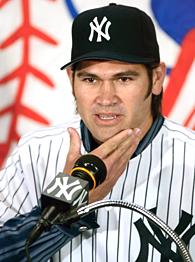
Fighting Words Q&A: Johnny Damon

"Damon! Shave those sideburns!" Photo from this site.

One of the highest compliments I’ll offer a ballplayer is to say he’d be a nice guy if he was pushing papers—or, heaven forbid, covering sports—somewhere. That’s not to say most guys are jerks, rather, that sportswriters get such limited access to players that it’s tough to get an authentic read on their personalities.

They’re pretty well-trained to be polite and cordial in their interactions with us, so you don’t want to be That Guy who walks away from a three-minute conversation gushing about how Player X is an awesome guy with whom you have so much in common.

Conversely, like anyone else, they have bad days where they are in terrible moods, so just like you don’t want someone to judge your personality the day your computer has crashed and forced you to spend six hours talking to Dell’s “customer service,” you don’t want to judge someone after he’s just gone 0-for-6, blown a key save or gone through some stuff away from the ballpark.

And some people who might be kindly and familial in the privacy of their own home just don’t like talking about themselves or are suspicious and/or unsure about the media in general, so it’s not fair to assume they’re bad guys when they give little or no time to reporters. Some of the best people I know would be horrible, horrible interviews. If my Dad was a ballplayer, he would have made Eddie Murray look loquacious, I am sure of it.

But two years covering Johnny Damon makes me pretty confident that he’s a nice guy by any standard. I never saw him turn away an interview request and never saw him lose his cool, even when he was being asked tiresome questions about his hair every single day in 2004 and 2005.

He also treated everyone the same regardless of experience or affiliation. My favorite Damon story occurred during the summer of 2005, when I assigned a Damon story to a young writer who was making his first trip to Fenway. He introduced himself to Damon, who said he’d be glad to talk after batting practice.

Ninety or so minutes later, the writer and I are in the locker room when Damon walks in. He goes to his locker, puts a few things away and begins scanning the clubhouse. I saw someone ask him what he was doing and he said he was looking for a reporter to whom he was supposed to talk. Unbelievable.

Damon discussed his role as a team spokesman type in Boston as well as provides a glimpse at why he was so patient and generous with his time in this interview, conducted in May 2006 at Yankee Stadium after Damon cut his hair and joined the Yankees as a free agent. It was the second interview we did for Fighting Words; the first was in the summer of 2004. Hope you enjoy:


How would you summarize the 2005 season?

I know I went in expecting to win another World Series and I think everybody thought we would too. But nobody realized that we ran into some major injuries—Schilling and Foulke—so that kind of dropped us down a little bit. And then signing a guy like Renteria was a huge boost for us, but losing Cabrera was pretty devastating too. We also went into the season without two of our starters that were there [in 2004], so it was a new feeling of guys that never played in a big market all of a sudden had to and had to help defend a world championship. There were lots of ups and downs, but we got back to the playoffs and we gave ourselves a chance. But no one had a chance against the White Sox last year.

How about the coverage of the Red Sox? How did it change after they won the World Series?

I think they were less reactionary. I think they kind of understood that the team’s nonchalant attitude—we lose and we’re just well, we’ll be al right—that’s how our team always approached stuff. We knew it was just a matter of time and it was a long season and all the players knew that. And I think we helped the media understand that it’s not as life or death as it may have been.

How important was it to have guys like yourself and Kevin Millar to absorb the media attention?

I think it was very important, because I think Boston could really tear up a player—Boston, New York. But if you have players all going in the same direction, it makes it a lot easier, because we had each other’s backs. If somebody made a mistake that cost us the game, we blamed it on the whole team. And I think certain guys understood that and liked it, just because there was a lot of pressure. Every opportunity I had, it was always my fault, and not because it was, but because I can deal with it. I can deal with people saying ‘Oh Damon, it was his fault.’ I can deal with it.

How different is the media here in New York?

I learned so much about being in Boston about the media that it’s been an easy transition for me. Obviously, I need to go out and do well. That and the way I play—the way I hustle—I think you win over fans right away. But you do have to continue to hit, you do have to continue to produce and win.

Are there more guys here to handle the media overflow?

Well, you’ve got six or seven potential Hall of Famers here, a lot of superstars. And there’s always a story. Boston, you have the same thing, but you might have one, definitely two or three Hall of Famers. The New York media knows that if they want a story after the game, you’ve got to go to the person who did something in the game or they’ll be gone and they don’t have a story. So it’s been easy. I come back to my locker sometimes thinking ‘OK, I’m here, let’s talk’ and [nobody is there].

That wasn’t the case in Boston, where you talked after every game no matter what you did or didn’t do.

Right, right. And not by choice. But I just remember walking in there [in 2002], how everybody just ran away and always put the blame on something else instead of themselves. I was one of the first ones—or maybe the first one [to act differently]. There’s no reason for them not to stick it on themselves. But a lot of players can’t admit that, and that’s too bad.

Why are you so comfortable dealing with the media?

I just don’t hide from the truth. The stats don’t lie, the scoreboards don’t lie. You can always look and say I struck out with the bases loaded [or] I came through with a bit hit. That stuff, you know? As long as it stays within the realm of baseball, it’s easy to talk about.

How much of that is your upbringing?

My parents taught me well and just taught me how to respect everybody. That’s a very important thing. I’m running into people nowadays who, because of the way I dress—I go into a clothing store or a jewelry store and they just don’t want to deal with me. It’s unfortunate people, with their stereotypes. It’s happened to me, and not only recently. Long hair [and] short hair.

Email Jerry at jbeach73@gmail.com.

Friday, June 5, 2009

Leaning on Beckett good baseball business


Josh Beckett hasn't been taking it easy this year. Photo from this site.

Josh Beckett had perhaps his most impressive regular season start as a member of the Red Sox Wednesday, when he carried a no-hitter into the seventh inning and ended up allowing three unearned runs on two hits and two walks while whiffing nine over 7 2/3 innings in the Sox’ 10-5 win over the Tigers.

As fascinating as it was to watch Beckett flirt with the no-hitter, the most interesting thing about his performance was in the box score: One hundred nineteen pitches. It was the 10th straight start in which Beckett has exceeded 100 pitches and kept him on pace for the busiest season by a Sox starter since Terry Francona became manager in 2004.

Beckett has thrown at least 100 pitches in 10 of his 11 starts (he threw 93 in the opener against the Rays), has exceeded 110 pitches seven times and is averaging 112 pitches per start. If he maintains that kind of workload, he’ll almost certainly break the Francona-era records for most 100-pitch starts (26 by Curt Schilling in 2004), most 110-pitch starts (17 by Daisuke Matsuzaka in 2007) and highest average pitch count (109 by Matsuzaka in 2007). He’s less likely to match or exceed the records for highest pitch (133 by Schilling in 2006) or the most 120-pitch outings (six by Matsuzaka in 2007).

It says a lot about how baseball has evolved when two months of 100-pitch starts send a guy to Baseball-Reference.com for hours (or maybe it just says something about me). We’re so used to big red flashing lights accompanying the 100-pitch mark that the first instinct is to wonder if Beckett is being overworked.

But immersion in the numbers indicates Beckett’s workload is perfectly reasonable. He’s only averaging six more pitchers per start than Jon Lester and 12 more pitches per start than Tim Wakefield.

And Beckett—who, at 29, has pitched 200 innings just twice due to a variety of injuries but who hasn’t undergone an operation on his right arm—will never be better equipped to throw more than 100 pitches every five days than he is right now.

This is also the first time under Theo Epstein that the Sox have had an ace in the prime of his career. So why shouldn’t the Sox take advantage of the rarest commodity in baseball and allow their best pitcher—and the one best-prepared for a heavy workload—to pitch deeper into games than most, especially given the number of close games the Sox have played with Beckett on the mound? The game Wednesday marked only the third time this season Beckett exited with a lead or deficit of more than two runs.

In addition, it’s made sense for the Sox to go longer with Beckett in the three starts in which closer Jonathan Papelbon was not available. Papelbon threw 39 pitches Apr. 11, the day before Beckett threw 103 pitches against the Angels. Papelbon threw 32 pitches May 4, the day before Beckett threw 108 pitches against the Yankees. And Papelbon threw 35 pitches Tuesday.

What is interesting is to wonder how Beckett’s workload will affect the Sox’ plans after next season, when his contract expires (the Sox’ $10 million option for 2010 vests if he makes 28 starts this year). If Beckett remains healthy through 2010, he’ll be the unique no. 1 starting pitcher who hits free agency at or near his peak.

But the Sox aren’t in the business of paying for past performance, and he’s almost certainly gone if he’s looking for CC Sabathia-type money. Even if he’s not, the Sox—with an enviable stockpile of young arms throughout the minor league system—may decide they’ve already gotten the best years of Beckett’s career and that it’s better to reinvest elsewhere.

So from a pure business standpoint, it makes sense for the Sox to get all they can out of Beckett this year and next. The Indians and Brewers wrung all they could last year out of Sabathia, who threw 100 pitches 29 times in 35 starts for the two teams, exceeded 110 pitches 16 times, averaged 109 pitches per start and pitched on three days’ rest in each of his final three outings for the Brewers as he helped pitch them into the playoffs for the first time since 1982.

Sabathia profited, too, to the tune of the seven-year, $161 million deal he signed with the Yankees in December. The Yankees would seem to have plenty of reason to proceed cautiously with him, especially since he can opt out after three years and would be far less likely to do so if his arm explodes. But the Yankees have worked Sabathia as hard as the Indians and Brewers did last year: He has thrown at least 100 pitches in each of his last six starts, in all but two of his 11 starts overall and is averaging 110 pitches per outing.

Of course, why wouldn’t the Yankees want what they paid for out of their 28-year-old former Cy Young Award winner? The Mets played it safe with Johan Santana last year and missed the playoffs as a result: They lost three games in which Santana was pulled with the lead or the score tied after 105 pitches or less.

Perhaps the Sox and Beckett will spend the rest of this season and next season maximizing their relationship. Even if that’s not the Sox’ goal, it makes even more sense, from a purely baseball perspective, to rely as much as they can on him.

Email Jerry at jbeach73@gmail.com.

Thursday, June 4, 2009

America digs the long ball, not a mulleted 299-game winner

Hey! We've got a 299-game winner over here! (Or: All business in the front, 299 wins in the back.) Photo from this site.

Randy Johnson’s first attempt at becoming the 24th 300-game winner was rained out after a four-hour delay last night. He’ll make his second first attempt at the milestone this afternoon in the first game of a doubleheader in Washington, which is a lot like Pearl Jam playing the second stage at Lollapalooza (which, much to my surprise, still exists, albeit only in a three-day format in Chicago).

Yet Johnson going for his 300th win in an afterthought afternoon game played in front of what will almost surely be a sparse crowd makes a whole lot of sense considering America’s response to Johnson’s pursuit has been a giant yawn. No round-the-clock coverage on ESPN (of course, things might be different if Johnson threw a football or shot a basketball), nor is a big deal being made of the pursuit on any of the major sports and news sites.

How is this possible? The countdown to 300 should be one of reverential anticipation, one in line with its status as baseball’s ultimate career achievement.

Is Johnson accomplishing the feat in anonymity because of his prickly personality and journeyman-like travels? Yahoo!’s Tim Brown had a hard time finding an ex-teammate in Arizona who was excited over Johnson’s imminent entry into the 300-win club. But Johnson surely isn’t the first 300-game winner to rub teammates the wrong way, nor will he be the first to collect his 300th win with a team with whom he’s not easily identified.

Phil Niekro won his 300th game for the Yankees, for whom he pitched two seasons after 20 years with the Braves. Don Sutton won his 300th game for the Angels, the fourth team he played for in a seven-year span after he spent the first 15 years of his career with the Dodgers. Tom Seaver won his 300th game for the White Sox, for whom he pitched only 2 ½ seasons. Braves legend Tom Glavine won his 300th game for the Mets, with whom he always seemed an odd fit despite five seasons in Queens. And you could probably win a lot of bar bets armed with the knowledge that Gaylord Perry won his 300th game with the Mariners, his seventh big league team and a club for whom he won a grand total of 13 games.

But I also don’t recall a whole lot of hype surrounding Glavine and Greg Maddux when they approached 300 (there was plenty of buildup for Roger Clemens’ 300th win in 2003, but if there’s anything that guy knows how to do, it’s make a scene).

Is this more proof that, to paraphrase the awesome ‘90s shoe commercial featuring Glavine and Maddux, that fans dig the long ball? But even if that’s the case, wouldn’t the explosion in offense that has lessened the luster of 500 homers also increase the prestige of 300 wins?

The 500-homer club has nearly doubled—from 13 to 24—over the last 10 years, though it could be a while before it expands again. Carlos Delgado is 27 homers away but out for months after hip surgery, while Chipper Jones would still be 15 homers shy of 500 at the end of his age-39 season in 2011 even if he hits as many homers (77) from 2009-11 as he did from 2006-08. The next member of the 500-homer club is probably Albert Pujols, who, at 335, should be more than halfway to Barry Bonds by the time he turns 31 in 2011. (If, of course, you believe that Pujols was really born in 1980)

But after Johnson, we’re almost certainly looking at a decade or more before the next 300-game winner joins the club. Nobody else is knocking on the door of 300, unless you count Jamie Moyer, and since he’s 50 wins away at age 46, you probably shouldn’t, my post from last month excepted.

After Johnson and Moyer, only two active players have as many as 200 wins, and there is no way Andy Pettitte (220) and John Smoltz (210) stick around long enough to get to 300. To give you an idea of just how far off the next 300-game winner is, realize that the third-winningest active pitcher is Tim Wakefield with 184. Even if he wins 17 games this year, bringing his career total to 195, he’d have to average 14 wins a season for another eight years—through his age-51 year—to get to 300 wins. He’s got a rubber arm, not a robotic one, folks.

With no 300-game winners on the horizon, the urge is to write that Johnson will very likely be the last of the breed. And sure, with starters throwing less than ever before and the four-man rotation not likely to return any decade soon, there’s a chance that the baseball fans of the 22nd century will look back on the opening days of the 21st century—during which four pitchers reached the 300-win mark in a span of five years—much like we do the late 19th century and early 20th century, when it wasn’t unusual for players to leg out 20 or more triples in a season. Only seven players have done that since 1950.

But history suggests those fans will be a lot less blown away by the concept of 300 wins in a career than we are by 30 triples in a season, even if the next 300-game winner is a decade or more away. Such a drought is not unprecedented: Grover Cleveland Alexander won his 300th game in 1924, after which only three players—Lefty Grove in 1941, Warren Spahn in 1961 and Early Wynn in 1963—reached the mark in the next 57 years.

Perry, though, began a rush of 300-game winners when he joined the club in 1982. Johnson will be the 10th pitcher to reach 300 wins in the last 27 years. There were only nine 300-game winners between 1888 and 1915, way back when men were men, pitchers started and completed 154 games a year and threw until their arms fell off, at which point they taught themselves to pitch with their other arm.

Johnson will also be the fourth pitcher to spend his entire career in a five-man rotation to reach 300 wins, indicating it’s not inconceivable the present-day aces have a better shot than we might believe at joining the club. Here’s four possibilities to follow in the footsteps of Johnson, Glavine, Maddux and Clemens as 300-game winners in a five-man era:

—Roy Halladay, 140 wins. Won 113 games from 2002-08. If he maintained that pace from 2009-15, he’d be at 244 wins at age 38. Halladay would have to average 17 wins per season into his age-42 season in 2019 in order to win 300.

—CC Sabathia, 122 wins. Won 117 games from 2001-08. If he maintained that pace from 2009-16, he’d be at 234 wins at age 36. Sabathia would have to average 15 wins a season for the next 12-plus seasons—taking him into his age-41 season in 2021—in order to win 300.

—Mark Buehrle, 128 wins. Won 118 games from 2001-08. If he maintained that pace from 2009-16, he'd be at 240 wins at age 37. Buehrle would have to average 15 wins a season for the next 12-plus seasons—taking him through his 42nd birthday in 2022—in order to win 300.

—Johan Santana, 116 wins. Won 98 games from 2003-08. If he maintained that pace from 2009-14, he would be at 207 wins at age 35. He’d have to average 17 wins a season for the next 11-plus seasons—taking him through his 41st birthday in 2020—in order to win 300.

Of course, all caveats apply about how it’s folly to try and project the performance of pitchers because there’s just so much that can go wrong. A few years ago, I thought Mark Mulder might have been the best young candidate for 300 wins. He won 97 games in his first six seasons, at which point he was just 28. But he’s won just six games since then thanks to multiple shoulder injuries that will likely end his career. June 15 will be the third anniversary of his most recent victory.

It’s also impossible to project who will beat the odds and be a much better pitcher in his 30s than in his 20s. Do you think anyone foresaw 300 wins for Johnson on Sept. 10, 1993, when he turned 30 with all of 64 wins to his credit?

Maybe Josh Beckett, who won his 95th game last night and is 11 months away from his 30th birthday, is as brilliant in his 30s as Curt Schilling, who won 155 games during that decade, and is within 40 wins by his 40th birthday in 2020.

Or perhaps the next 300-game winner is someone who isn’t yet eligible for arbitration (Tim Lincecum?). Maybe he’s someone who still can’t legally buy a beer (Stephen Strasburg?). Or maybe he hasn’t even hit puberty yet (a Little Leaguer somewhere?).

He’s probably out there, somewhere. But it’s going to be a long time before he becomes the 25th member of the 300-win club. Maybe by then we’ll be able to muster up the anticipation missing from Johnson’s pursuit.

Email Jerry at jbeach73@gmail.com.

Tuesday, June 2, 2009

Who are you and what have you done with the Yankees?

What? The Yankees are having fun? You cannot be serious! Photo from this site.

As surprising as it is to see the Yankees atop the AL East—and I don’t know about you, but it blew my mind that, until last Friday, they hadn’t been alone in first since the final day of the 2006 season, that’s like 872 years in Yankee fan years—it’s nowhere near as stunning as the method with which they’ve surged into first.

The Yankees played their 18th straight error-free game last night, breaking the record set by the 2006 Red Sox. This is a team that last year had immovable objects at first and short, the poster boy for indifference at second and a guy with a bad hip at third. Derek Jeter still needs 77 steps to get to anything not hit directly to him, but Robinson Cano and Alex Rodriguez are vastly improved over last year and Mark Teixeira’s defense at first base is as gorgeous as Jason Giambi’s was grotesque.

Most impressive of all is the lobotomy the Yankees have undergone. A franchise that used to play baseball as if it were a punishment suddenly seems to be having a blast.

The most valuable player in each game gets a WWE-style championship belt, or, if he’s lucky, a shaving cream pie in the face from A.J. Burnett. Players have video game tournaments. Teixeira is autographing for Jorge Posada a picture of Teixeira barreling into Posada during a 2006 game.

CC Sabathia took the whole team to the Cavaliers-Magic NBA playoff game Thursday and then did something even more amazing two days later, when he participated in those video games hours before his start against the Indians. Sure is a lot different than Roger Clemens rubbing icy hot (*cough* and God knows what else *cough cough*) on places that should never be anywhere near icy hot.

I have to admit: Even though I wrote thousands of words about the goofily good chemistry of the 2004 Red Sox, and believed every word of it, I roll my eyes every time I hear the Yankees and their announcers gush about how much this teams likes each other and how it has sleepovers during which they watch bad movies, order pizza in the middle of the night, crank call the Blue Jays, have pillow fights and put Brian Bruney’s hand in a warm bucket of water after he falls asleep.

They’ve defined joylessness for so long that it’s tough to conceive of anyone actually having a good time in the Bronx. I still picture Jeter, Andy Pettitte, Jorge Posada and Mariano Rivera—the four holdovers from the dynasty—harrumphing about all the damn kids making all that noise.

Along those lines, is absolutely hilarious to watch Yankees games in which Paul O’Neill—who was the leader of the grumpy, this-is-no-fun-and-anyone-who-thinks-otherwise-will-be-punished-to-the-fullest-extent-of-the-kangaroo-court-that-doesn’t-exist Yankees—is in the broadcast booth. I swear, you can hear him cringe whenever his partners talks about how much fun these Yankees are. Back in my day we broke bats and carried on like three-year-olds! And we liked it!

But George Steinbrenner is no longer in the picture and his kids seem to like running the team with a mostly sane hand. I still think Joe Girardi is a humorless drill sergeant, but maybe he really is pulling a Tom Coughlin and producing a nicer, friendlier skin in order to save his, well, skin.

And maybe Brian Cashman really did find the perfect mix like the Red Sox did in 2003-04, when they imported a bunch of guys who just didn’t give a crap about the team’s history or Curses or anything like that. Nick Swisher seems to be the Kevin Millar of these Yankees and Sabathia, Teixeira and Burnett don’t seem intimidated yet by the mystique and aura of the Yankees. And wouldn’t it be interesting if Johnny Damon, a Dan Duquette holdover who ended up being one of the symbols of the Sox personality overhaul, served in a similar role with the new Yankees?

Of course, it’s still early, and there’s plenty that can go wrong to turn the sunny mood sour. The most reliable reliever in front of Rivera is Alfredo Aceves, who began the year at Triple-A. There’s little depth at the minor leagues if the 30-somethings that make up the Yankees’ core begin to break down. And the approaching summer promises to be the most pressure-packed any of the newcomers have ever experienced.

Let’s also not forget that those 2006 Sox finished a distant third despite their spate of defensive brilliance. And like those Sox, who fattened up on an easy schedule prior to the All-Star Break, these Yankees are feasting on sub-.500 opposition: They’re 22-9 against teams with losing records but 8-12 against teams with winning records. So while these Yankees are a whole lot more fascinating than a month ago, let’s see how they fare in Boston next week before declaring their one-year playoff drought (that’s like 436 years in Yankee fan years!) over.

Email Jerry at jbeach73@gmail.com.