Showing posts with label Clay Buchholz. Show all posts

Friday, September 25, 2009

Bits and Bytes: Five-year itch?

Sorry for the longer-than-anticipated sabbatical, I had some other work that unexpectedly took up most of my week. Got a few things Sox- and Pats-related I’d like to chew on and a couple Q&As to post next week, so please stop by for those posts. But, in the meantime here’s a couple quick hits to get back into the flow heading into the weekend:

—None of this should be used in trying to project how the Red Sox will fare in the playoffs, but nonetheless, if you’re a Sox fan (and let’s face it, if you’re reading this, chances are pretty good you are), you’ve got to like the similarities between the end of this season and the end of the 2004 regular season.

As they did in 2004, the Sox took a couple weeks to gel following a blockbuster trade before authoring a blistering sprint to the finish line. They went 8-7 in the first 15 games following the Nomar Garciaparra trade in 2004 and a sizzling 34-12 thereafter, a stretch that included 16 wins in 17 games at one point.

The Sox took a bigger post-July 31 stumble this year, when they went 3-6 in the first nine games following the Victor Martinez trade, but they’re 29-14 since then after tonight’s loss to the Yankees.

Then, like now, the Sox’ surge allowed them to bury the Rangers in the wild card race. In fact, how’s this for a fun bit of coincidence: Through Aug. 23, 2004, the Sox were 70-53 and the Rangers were 69-54, marks that left the teams just behind the wild-card leading Angels (71-52). While the Angels stormed past the slumping Athletics to win the AL West, the Sox left the Rangers (and the Athletics) far behind by finishing the season on a 28-11 tear. The Rangers went 20-19 over the same span.

Through Aug. 23 this year, the wild card-leading Sox were 70-53 and the Rangers 69-54. Since then, the Sox are 21-9 and the Rangers 15-15.

And just like 2004, the Sox, in running away with the wild card, also put some unexpected pressure on a Yankees team that was cruising towards the AL East crown and gave some meaning to a series between the two teams on the penultimate weekend of the season.

That 16-1 stretch five years ago allowed the Sox to shave a remarkable eight games off the Yankees’ lead—from 10 ½ games to 2 ½--in just 19 days. The Sox closed the gap to two games on Sept. 8 and were 4 ½ out the morning of Sept. 24, when the Yankees arrived at Fenway. A 6-4 win by the Yankees that night in the Pedro Martinez “Daddy” game all but ended the race.

The Sox’ recent 10-1 run cut the Yankees’ lead from nine games to five games. The deficit was at 5 ½ entering tonight.

That said, these Yankees are also 29-14 in their last 43 games and are finishing the season in far better fashion than the 2004 club, which was 26-19—7 ½ games worse than the Sox—in its final 45 games.

—As I’ve noted here a few times this season, I’m not very good when it comes to predictions. So now seems like a good time to clarify what I meant in April when I wrote the Indians would win the World Series. I actually meant they’d endure the worst stretch the franchise has seen since 1931. That’s really freaking remarkable, considering the Indians’ abject awfulness from 1932 through 1988 inspired a movie franchise.

But hey, not all my predictions were historically bad. I wrote in April that Clay Buchholz would win many more games than Brad Penny and John Smoltz combined. That won’t happen—with two starts left, Buchholz has seven wins, two fewer than Penny (seven) and Smoltz (two) recorded before they took their rightful spot over in the JV league—but Buchholz’ recent dominance (5-0 with a 1.32 ERA, 0.91 WHIP and .185 batting average against in his last six starts) indicates Theo Epstein might have made a rare mistake in bringing aboard the rehabbing Penny and Smoltz at the expense of Buchholz, who did, admittedly, have an awful season last year.

—Speaking of predictions, sort of, all those pixels spilled by myself and others earlier this summer about the possibility of Tim Wakefield not only succeeding Cy Young and Roger Clemens as the Sox’ all-time winningest pitcher but also pitching up to or even beyond his 50th birthday look sadly foolish these days.

Wakefield has made just three starts since the All-Star Break due to a fragmented disc in his back that will likely require surgery (and yeah, we were wrong in wondering if his back injury was just a convenient way to get Wakefield some rest and Buchholz some work). He has looked every day his 43 years in those starts, often appearing as if he can barely jog to cover a base, even though he has made his last two starts on nine days rest and 15 days rest, respectively, and is expected to get at least eight days rest before he next takes the mound. Given how much recovery time he needs between starts, it seems inconceivable he’ll make the playoff roster.

It’s long been assumed the Sox would have Wakefield back on an annual basis thanks to his team-friendly perpetual option, but this is the fourth straight season in which he has been injured in the second half and he is almost sure to end the season with his lowest innings total since arriving in Boston in 1995, a pretty startling feat considering he pitched predominantly out of the bullpen from 1999 through 2002. Can the Sox really spend $4 million on a 43-year-old pitcher who may be a half-season hurler?

The Hartford Courant’s Dom Amore suggests Wakefield should announce his retirement and make a farewell start at Fenway against the Blue Jays or Indians. While something that formal is unlikely to occur, it’s fair to wonder if Wakefield’s next start at Fenway will in fact be the last of his career—and to preemptively lament how cruel it would be for Wakefield to travel so far to approach the most hallowed record in team history and still fall short.

Email Jerry at jbeach73@gmail.com or follow him on Twitter at http://twitter.com/jerrybeach.

Wednesday, July 22, 2009

Are Sox prepared enough to deal with Wakefield what ifs?

What do the Sox do if Buchholz shines in Wakefield's absence?

Tim Wakefield went on the disabled list Tuesday afternoon in what was either the last in a series of remarkable coincidences or the final step in a meticulously plotted chain of events designed to provide the nearly 43-year-old some rest while allowing the Sox to maximize the depth of their starting pitching.

I’m going to assume it’s the latter, because even Quentin Tarantino would have trouble penning a script with this many random twists of fate. Think about all that transpired leading up to yesterday’s news:

—Wakefield made his final start prior to the All-Star Game July 8.

—Terry Francona announced on July 12, two days before the All-Star Game, that Wakefield would not pitch again until July 22, providing him 13 days of rest between starts.

—Francona also announced July 12 that the Sox—who were off on July 16, the first day of the second half, before playing six straight games—would employ a six-man rotation for that cycle of games and that Clay Buchholz would make the Sox’ first start of the second half against the Blue Jays on his regular four days rest.

—Joe Maddon said the day of the All-Star Game that he would utilize Wakefield as an emergency pitcher, one he would not call upon unless the game went deep into extra innings and he needed someone to throw multiple frames.

—Wakefield did not pitch in the All-Star Game and hurt his back in a side session in Toronto Saturday, leading the Sox to place him on the shelf and replace him with Buchholz, who starts tonight in Texas on, amazingly enough, his regular four days rest.

—Wakefield is placed on the disabled list retroactive to July 18, meaning the earliest he can return is Aug. 2—two days after the trade deadline.

If this really was all part of a grand plan, it’s further confirmation of how careful and thorough the Sox are in all matters, baseball and otherwise. If the Sox have been planning for Buchholz to take Wakefield’s spot in the rotation for the rest of July, then they’ve exhibited even more foresight than we gave them credit for last week.

It doesn’t help the Sox, from a competitive standpoint, to officially announce they plan to give Wakefield—who has been injured in each of the last four seasons—a few weeks off, even if they have in the past alluded to such plans for their pitchers. The longer a guy like Buchholz toils away at Pawtucket, the better the Sox’ depth looks to potential trading partners as the July 31 deadline approaches. And yet by bringing him up now, the Sox can see their 4-5-6 starters—John Smoltz, Brad Penny and Buchholz—pitch twice more apiece as they try to figure out what to do with the glut of starters come August.

That said, it’s also quite fair to be skeptical about the severity and location of Wakefield’s injury. During the AL Division Series two years ago, Francona admitted the Sox fudged the details of Wakefield’s “back” injury, which was first revealed to be a shoulder injury and then later a small tear of the right rotator cuff.

It’s also worth wondering if Wakefield, who authored the feel-good story of the first half, is headed for a far less satisfying second half even if he does return within a couple weeks. The last time Buchholz made a start for an ailing Wakefield, he threw a no-hitter. That probably won’t happen again tonight, but it’ll be interesting to see what happens if Buchholz strings together a couple good starts in Wakefield’s absence and the club still has five other starters when Wakefield returns.

The Sox can only reward Buchholz with trips back to Pawtucket so many times before they run the risk of damaging relations with their potential future ace. Smoltz is a future Hall of Famer whom the Sox signed with his October brilliance in mind, so he’s not likely to be dumped. If it comes down to Wakefield vs. Penny, Wakefield probably wins based on recent performance as well as organizational stature.

But still: As nice a tale as Wakefield spun the first three-plus months of the season, the fact is he was a league average pitcher outside of his inflamed win total. What if he’s clearly the Sox’ sixth-best starter when he returns? As studious as the Sox are about everything, I can’t imagine there’s any preparing for a scenario that awkward.

Email Jerry at jbeach73@gmail.com.

Tuesday, July 14, 2009

It’s back! It’s back! The six-man rotation is…oh crud

The gals at Coyote Ugly didn't believe in the six-man rotation, either. Photo from this site.

We all have our weaknesses—a penchant for chasing something that’ll never work no matter how good it might sound, or liking something we know is no good for us. In lieu of pondering how the first analogy might symbolize my career pursuits, I’ll just say that any time Coyote Ugly is on, I’m watching. What? I like it for the crackling dialogue and non-wooden acting! Until my wife pointed it out, I didn’t even know that the women in the movie spend it in various stages of undress.

Anyway, if you’re among the handful of loyal readers here, you know I have a major crush on the idea of a six-man rotation. So I have to admit my heart skipped several beats Sunday when I heard Terry Francona line up the Red Sox’ rotation following the All-Star Break, one that features Clay Buchholz as well as five other starters.

Here it comes, I thought. My big break! Francona’s going to say he and Theo got the idea from reading some rambling blogger and that they thought it was a great idea and they’re saying the hell with baseball convention, we’re turning it on its head!

Alas, there will be no reinventing the rotational wheel, at least not now. And as fond as I am of breaking down how a six-man rotation would work, I do understand that the vast majority of teams in baseball have a hard enough time finding five passable starters, never mind six, and that a true six-man rotation would limit starters to 27 turns apiece. Do you want Josh Beckett taking the ball only 27 times a year? Or Jon Lester?

And for all the pixels I wasted writing about the six-man rotation last month, the benefit of hindsight suggests the Sox were never all that worried about it actually occurring, not with Daisuke Matsuzaka’s inability to resemble a competent big league starter.

But while the Sox aren’t going with a permanent six-man rotation, their decision to implement it for the first two series following the All-Star Break is more proof they’re better prepared and more forward-thinking than anybody else in baseball.

Using the All-Star Break to give everyone in the rotation a mini-vacation is a great idea. But I wonder how many teams would take a look at their 25-man roster and scratch the idea, declaring that they don’t have six starters.

Along those lines, I doubt it’s coincidence that Buchholz has been pitching every fifth day since June 17. Bringing Buchholz up for one start doubly benefits the Sox, who get to reward a top pitching prospect (well, technically he’s not a prospect since he’s no longer a rookie, but you know what I mean) while also helping out the five pitchers who should construct the rotation the remainder of the season.

An eight-day break—which Brad Penny, Lester, John Smoltz and Beckett each get—is a lengthy respite, but not so long that they’ll begin to collect cobwebs on the shelf. Tim Wakefield gets 13 days, which seems like a good move given the injuries he’s battled in the second half of each of the last three seasons

“We wanted to line everybody up and not have anybody have to tell Smoltz ‘Watch the All-Star Game, and if Wake pitches, you throw a side’ after the game,” Francona said. “It just didn’t make a lot of sense. We are trying to incorporate rest, trying to keep everybody on a consistent [pattern], not just one guy [gets] 10 days and one guy 15 days. We are real comfortable with the way this is setting up.”

They should be. A phenom gets another taste of the big leagues and the rest of the rotation doesn’t miss a start yet gets the type of extra rest that should come in quite handy down the stretch. Savvy, at levels even Coyote Ugly cannot hope to match, no matter how often I watch it.

Email Jerry at jbeach73@gmail.com.

Tuesday, July 7, 2009

Of Bates, Bailey and Brown…and Buchholz’ not-so-short-stop at Pawtucket

It's been a good month for longtime Red Sox prospects Dusty Brown and Aaron Bates. Photo from this site.

Maybe Clay Buchholz should have remained a shortstop. Buchholz continues to pine away on the farm despite posting ace-caliber numbers for Triple-A Pawtucket, though it will be interesting to see what happens if John Smoltz, who struggled for the second time in three starts in a 6-0 loss to the Athletics Monday, is ineffective again against the Royals this weekend.

Meanwhile, it remains a good month for the Sox’ second-tier position prospects. Dusty Brown, a 2000 draftee, earned his first recall June 21 but did not record an at-bat in four days with the Sox. Aaron Bates won’t have to worry about heading back to the minors before he steps to a big league plate: Bates was promoted to the Sox last night to replace the injured Jeff Bailey and went 0-for-3 as the Sox’ first baseman.

That the Sox have called up Bates and Bailey, in particular, points to their thoroughness and resourcefulness on the farm.

Bailey was signed as a minor league free agent by the Sox following the 2003 season, at which point he was a displaced catcher with all of 24 Triple-A at-bats on his resume. Non-prospects who are in their mid-to-late 20s, limited to first base or a corner outfield position and lacking a spot on the 40-man roster are the type of players who are usually ignored by the parent club no matter how well they fare, and it seemed as if Bailey was consigned to 4-A status when he performed well for Portland and Pawtucket for the next three-and-a-half seasons. But the Sox recalled him for three games prior to the All-Star Break in 2007 and he earned another cup of coffee last year before spending more than a month this season with the Sox in a reserve role.

Bates was a third-round pick in 2006 who surged into Double-A a little more than a year after he was drafted, but he stalled there and was surpassed—on the organizational totem pole, if not on the actual minor league ladder—by fellow ’06 draftee Lars Anderson. And with Anderson at Portland this season, the Sox moved Bates to left field, where his defense was a work in progress when my wife and I saw him misplay a ball against Binghamton in upstate New York in mid-April.

But Bates hit .340 with 39 RBI and 20 extra-base hits in 206 at-bats for the Sea Dogs to earn a promotion to Pawtucket, where he was hitting .182 in 88 at-bats when Bailey’s injury created his big league opportunity.

Bates is one of three 2006 draftees currently with the Sox, a pretty impressive haul for a class that is not held in as high regard as the 2005 batch and one with several notable players (Anderson, Jason Place, Caleb Clay and Josh Reddick, to name a few) still in the developmental phase and still viewed as potential big leaguers.

It’s probably little consolation to Buchholz, but these things are as much a matter of good timing as anything else. Bailey and Brown got their initial call-ups when the sox wanted depth as Youkilis and Jason Varitek, respectively, battled nagging injuries. And Bates needed 754 at-bats at Double-A to earn the promotion to Triple-A but just 88 at-bats at Pawtucket before he received a ticket to Boston.

Good timing. If I’m Buchholz, I start taking grounders at short again, just in case.

Email Jerry at jbeach73@gmail.com.

Tuesday, June 16, 2009

Joy of six?

Will going to a six-man rotation allow the Sox to blossom? Boooooo!! Boooooo!!! Terrible pun! Photo from this site.

Today is supposed to be the day the Red Sox announce what they’re going to do with John Smoltz and the challenge of working six starters into a five-man rotation. But Peter Gammons reported on Baseball Tonight last night that the Sox are likely going to remain in four corners mode, so to speak, for another week or so and that Brad Penny will probably start Wednesday against the Marlins while Smoltz makes one more start at Triple-A Pawtucket.

Gammons also indicated that keeping the status quo for another week will allow the Sox to “…wait and see what happens with Daisuke Matsuzaka, who hasn’t had the same stuff and could end up on the DL.”

But what if Matsuzaka pitches well enough against the Braves Friday to stay on the big league roster? That really wouldn’t do anything to solve the rotation in the long term, since regardless of how he fares Friday, Matsuzaka is still the weakest link in an otherwise sturdy chain.

Of course, as Tony Massarotti pointed out Monday, Matsuzaka’s contract makes it awfully difficult to send him to Pawtucket (or Portland, or Salem, or Greenville). And sending the $100 million man to the bullpen would be embarrassing, for both Matsuzaka and the Sox.

In addition, banishing Matsuzaka to the minors introduces another wrinkle: What do the Sox do if a rotation spot is created and Matsuzaka is pitching well in Pawtucket? Do they promote him and once again overlook Clay Buchholz, who is already tiring of life as The Best Pitcher Not Pitching In The Majors?

The Matsuzaka issue means the best solution—not a perfect one, but the least imperfect one—is going to a six-man rotation.

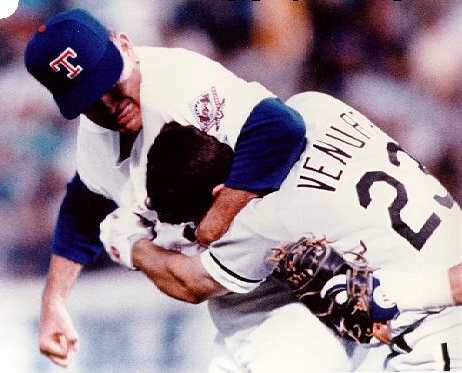
The problem with the six-man rotation, other than how the mere concept of it probably makes Nolan Ryan want to give anyone who suggests it the Robin Ventura treatment, is what a team will do if injury or ineffectiveness strikes a pitcher (or two). But the Sox are so deep that they could overcome multiple losses: Former starter Justin Masterson is in the bullpen and can either immediately become that sixth starter or make a spot start or two until the rotation can be realigned to the traditional five-man unit. And of course there’s always Buchholz in Pawtucket, as well as Michael Bowden.

Another problem unique to the Sox is that their no. 1 starter, Josh Beckett, doesn’t love the idea of a six-man rotation. Taking Beckett’s concerns into consideration (you’re welcome Josh) was a key factor when I mapped out a six-man rotation for the remainder of the season.

I don’t proclaim this to be perfect, but I think it could work beginning next Tuesday, the day after an off-day. The projected starters for the Sox’ final 99 games are listed at the end of this story, but here’s the rundown of the workload for the six Sox starters:

Josh Beckett: 19 starts (14 on regular rest***, two on five days rest, one on six days rest)
Jon Lester: 18 starts (nine on regular rest, four on five days rest, two on six days rest, one on seven days rest)
Tim Wakefield: 18 starts (five on regular rest, seven on five days rest, two on six days rest, two on seven days rest)
Brad Penny: 17 starts (seven on regular rest, four on five days rest, two on six days rest, two on eight days rest)
John Smoltz: 14 starts (one on regular rest, two on five days rest, two on six days rest, three on seven days rest, two on eight days rest, one on nine days rest, one on 10 days rest)
Daisuke Matsuzaka: 13 starts (none on regular rest, two on five days rest, two on six days rest, three on seven days rest, three on eight days rest, one on nine days rest)

***Regular rest is defined (well, by me, anyway) as a start made on four days rest or a start made on five days rest because of an off-day

Also, you’ll notice that each starter has two fewer starts listed inside the parentheses than outside them. That’s because I’m not counting the days of rest prior to his first start in this alignment, nor the days of rest prior to his first start after the All-Star Break (since it’s an obvious place to provide starters extra rest even for teams that aren’t trying to shoehorn six pitchers into five spots).

Beckett and Lester, not surprisingly, make the most starts on regular or nearly regular rest. Smoltz pitches almost exclusively on extra rest, which seems to be prudent given he’s 42, is coming back from shoulder surgery and was signed with October in mind. Wakefield, who has spent time on the disabled list in each of the last three seasons and turns 43 in August, gets more rest in the second half than he does the first though he still ends up with 18 starts, which is an acknowledgment of how solid he’s been most of the season.

I honestly intended for Penny to pitch with extra rest more often, but he’s pitched well enough—and, more importantly, seems healthy enough—to entrust him with mostly regular work. And Matsuzaka is the clear sixth starter because, well, he’s the Sox’ ninth-best starter at this point.

In addition, I’ve planned it so that the Sox have their three best starters—Beckett, Lester and Smoltz, the latter of whom is perhaps the best postseason pitcher of all-time—ready to start the first three games of the AL Division Series on regular rest, though it requires Smoltz making a tune-up start on three days rest on the regular season finale.

Obviously, there are tweaks that can be made. As well as Lester is pitching, there should be a way to make sure he makes as many starts as Beckett, but I do believe the Sox would love to find a way to somehow limit Lester’s innings in the second half so that he doesn’t end up throwing 230-plus frames for the second straight year. And the optimal six-man rotation would have Smoltz available out of the bullpen every time Matsuzaka pitches.

And crap, I didn’t even think about how rainouts could screw this up. Oh well. At least the Sox have already made their trip to Cleveland and therefore don’t have to worry about a game being postponed due to locusts.

Full disclosure time: I’ve had a crush on the idea of a six-man rotation since the end of the 2007 season, when I wrote a similar piece for Ye Former Employer. So all apologies if this sounds familiar, and I promise I won’t go to this well again this year. Probably.

The Sox have 99 starts to make, 99 starts to make…

June 16: Wakefield
June 17: Penny
June 18: Lester
June 19: Matsuzaka
June 20: Beckett
June 21: Wakefield
June 22: OFF DAY
June 23: Penny
June 24: Smoltz
June 25: Beckett
June 26: Lester
June 27: Wakefield
June 28: Matsuzaka
June 29: Penny
June 30: Beckett

July 1: Lester
July 2: OFF DAY
July 3: Smoltz
July 4: Wakefield
July 5: Penny
July 6: Matsuzaka
July 7: Beckett
July 8: Lester
July 9: Smoltz
July 10: Wakefield
July 11: Penny
July 12: Matsuzaka
July 13-15: ALL-STAR BREAK
July 16: OFF DAY
July 17: Beckett
July 18: Smoltz
July 19: Lester
July 20: Wakefield
July 21: Penny
July 22: Beckett
July 23: OFF DAY
July 24: Lester
July 25: Matsuzaka
July 26: Wakefield
July 27: Smoltz
July 28: Beckett
July 29: Lester
July 30: Penny
July 31: Matsuzaka

Aug. 1: Wakefield
Aug. 2: Beckett
Aug. 3: OFF DAY
Aug. 4: Lester
Aug. 5: Penny
Aug. 6: Smoltz
Aug. 7: Wakefield
Aug. 8: Beckett
Aug. 9: Matsuzaka
Aug. 10: Lester
Aug. 11: Penny
Aug. 12: Wakefield
Aug. 13: Beckett
Aug. 14: Smoltz
Aug. 15: Lester
Aug. 16: Matsuzaka
Aug. 17: OFF DAY
Aug. 18: Penny
Aug. 19: Beckett
Aug. 20: Wakefield
Aug. 21: Lester
Aug. 22: Smoltz
Aug. 23: Penny
Aug. 24: Beckett
Aug. 25: Matsuzaka
Aug. 26: Wakefield
Aug. 27: Lester
Aug. 28: Penny
Aug. 29: Smoltz
Aug. 30: Beckett
Aug. 31: OFF DAY

Sept. 1: Wakefield
Sept. 2: Matsuzaka
Sept. 3: Lester
Sept. 4: Penny
Sept. 5: Beckett
Sept. 6: Smoltz
Sept. 7: Wakefield
Sept. 8: Lester
Sept. 9: Penny
Sept. 10: OFF DAY
Sept. 11: Beckett
Sept. 12: Matsuzaka
Sept. 13: Lester
Sept. 14: OFF DAY
Sept. 15: Wakefield
Sept. 16: Beckett
Sept. 17: Smoltz
Sept. 18: Penny
Sept. 19: Lester
Sept. 20: Matsuzaka
Sept. 21: Beckett
Sept. 22: Wakefield
Sept. 23: Penny
Sept. 24: Smoltz
Sept. 25: Lester
Sept. 26: Beckett
Sept. 27: Matsuzaka
Sept. 28: Wakefield
Sept. 29: Penny
Sept. 30: Smoltz

Oct. 1: Lester
Oct. 2: Beckett
Oct. 3: Wakefield
Oct. 4: Smoltz

ALDS (if the Sox open on Tues., Oct. 6)

Oct. 6: Lester
Oct. 7: Beckett
Oct. 9: Smoltz
Oct. 10: Wakefield

ALDS (if the Sox open on Wed., Oct. 7)

Oct. 7: Beckett
Oct. 8: Lester
Oct. 10: Smoltz
Oct. 11: Wakefield

Email Jerry at jbeach73@gmail.com.

Wednesday, May 27, 2009

Free Clay Buchholz!

"FOR THE LOVE OF GOD, LET THE BOY PITCH IN YOUR HOUSE!!" Photo from this site.

I imagine this is a bit of East Coast hyperbole that could be disproved by someone with a couple hours and Baseball-Reference.com at his/her disposal, but here goes: Since Major League Baseball expanded to 30 teams, I cannot imagine there has ever been a team with more starting pitching depth than the Red Sox have right now.

I mean, Clay Buchholz just carried a perfect game into the ninth inning Monday, and he’s no better than eighth on the Sox’ depth chart. Justin Masterson certainly ranks ahead of him, since he’s in the majors, and the Sox didn’t sign John Smoltz last winter so that they could send him to the bullpen or Pawtucket once his rehab assignment ends (he made his second minor league start last night and is on schedule to debut for the Sox in mid-June).

Buchholz is 3-0 with a 1.31 ERA and a 49/12 K/BB ratio in 48 1/3 innings at Pawtucket this year and 27-12 with a 2.29 ERA and a 466/107 K/BB ratio in 392 1/3 innings overall as a minor leaguer since he signed with the Sox in 2005. At Pawtucket alone, he is 8-5 with a 2.15 ERA and a 147/42 K/BB ratio in 130 1/3 innings over 25 starts.

Nick Cafardo made a good point in his Sunday notes May 17, when he wrote that more development wasn’t a bad thing for Buchholz since he was just approaching the 500 professional innings that big league teams used to think pitchers needed before they were ready for the majors. (He’s actually at 501 after Monday) Curt Schilling had 890 1/3 innings under his belt—including 725 1/3 at the minor league level—before his first full season with the Phillies in 1992.

But still…Buchholz seems pretty darn developed right now. My guess is the Sox know Buchholz is ready to contribute at the big league level, but that they don’t mind being extra careful in light of his struggles last year.

In addition, the Brad Penny experiment has gone much better than most of us anticipated. Bob Ryan said yesterday he thinks the Sox are going to deal Penny before the trading deadline, but that still leaves them with six starters for five spots if Smoltz returns. And if Josh Beckett, Daisuke Matsuzaka, Jon Lester and Tim Wakefield are all healthy, then that would, presumably, leave Buchholz in Pawtucket.

Might it be time for the Sox to go with the six-man rotation, as it appeared they might be ready to do when they re-signed Schilling in November 2007? Like then, they’ve got the optimal staff with which to try it: A pair of 40-somethings in Smoltz and Wakefield, a hurler who is used to pitching once a week in Matsuzaka and a couple of young homegrown starters whose innings the Sox would like an excuse to limit in Lester and Buchholz.

Theo Epstein said on the conference call announcing the return of Schilling that the Sox had pondered the possibility of a six-man rotation but that he didn’t want to commit to it because those things have a way of not working themselves out. And that’s exactly what happened: Schilling never threw another pitch and Sox starters were so decimated by injuries that the likes of David Pauley and Charlie Zink made starts for Boston last year.

If the Sox have better luck this season in the injury department, maybe they can unofficially go with the six-man rotation by handing every starter some “structured time off,” as Epstein called it in November ‘07. Conceivably, the Sox could give a different starter two weeks off beginning July 1—these would be like furloughs, except, you know, they’d get paid—and run through the rotation by the end of the regular season.

And with September roster expansion, the Sox would only have to come up with a DL-worthy ailment for four pitchers. Or maybe only three, since the All-Star Break provides a chance to give someone 10 days off anyway. Or maybe only one, since Lester and Buchholz can still be optioned out.

I’m just thinking out loud. Such suggestions are easier made than implemented, especially when it comes to something as radical as changing the big league rotation as we know it. But geez, somebody’s got to do something to get Buchholz up to the majors before he makes a run at Schilling’s minor league innings total, right?

Email Jerry at jbeach73@gmail.com.

Monday, May 11, 2009

The Bard, Bard, Bard, Bard is the word


Rhode Island's own Peter Griffin has been calling for the Red Sox to recall Daniel Bard for weeks.

Unlike Hunter Jones and Michael Bowden, who had one big league appearance apiece under their belts when they were entrusted with a lead against the Yankees during a national TV game Apr. 26, there was no dramatic emergence on the big stage last night for Daniel Bard. But that didn’t diminish the pride felt by an organization that patiently oversaw Bard’s transformation from a potential draft bust who couldn’t find the strike zone as a starter to an almost incomprehensibly dominant late-inning reliever who could someday replace Jonathan Papelbon as the Red Sox’ closer.

“It’s exciting, obviously, and I’m really happy for Daniel with everything he went through that first year back in ’07 just to see how he responded to that situation,” Red Sox director of amateur scouting Jason McLeod said Sunday night. “And really, from that time and the time leading up to that winter, [he] really stepped into this new role with both his feet. And it really has just been a lot of fun for us to watch, when you see the hard work that he’s put into it get rewarded in terms of performance at the minor league level and then obviously with a call-up today. It makes everyone in the organization very proud.”

Theo Epstein probably had no idea in October 2006 that Bard would one day serve as the poster child for his re-commitment to player development. Bard, a first-round pick by the Sox that June out of North Carolina, signed with the Sox weeks earlier following a summer of negotiating. He made his professional debut the following spring at Single-A Lancaster, where he didn’t exactly provide the Sox an immediate return on their $1.55 million investment.

Bard, pitching in one of the most extreme hitter’s parks in minor league baseball, walked 22 and allowed 21 hits in just 13 1/3 innings over five starts. After a stint on the disabled list, he was demoted to Single-A Greenville, where he improved only slightly pitching at sea level: Bard walked 56, allowed 55 hits and posted a 6.42 ERA in 61 2/3 innings over 17 starts.

After the season, the Sox suggested he go to winter ball in Hawaii and pitch in relief. At the time, the Sox weren’t necessarily committing to him as a reliever: Management just hoped he’d be able to end the year on a positive note.

Bard continued to battle his control in Hawaii, where he had a 1.08 ERA and struck out 15 but also walked 15 in 16 2/3 innings. But McLeod sensed an increased confidence in Bard at the end of the season in Hawaii and believed he might have found a home in the bullpen.

“One thing I know we discussed that off-season was I know a lot of times when we saw Daniel as an amateur really dominate was in short stints, whether it be on the Cape or with Team USA,” McLeod said. “When he came out of the bullpen, you just kind of saw a different demeanor from him. He was much more aggressive in the strike zone and I think it just suits his personality a lot better.”

Nobody expected it to suit him as well as it did last season, when Bard—armed with a modified delivery he’d begun working on in Hawaii—began the season by striking out 43, walking just four and posting a miniscule 0.64 ERA in 28 innings at Greenville. He continued to impress at Double-A Portland, where he struck out 64, walked 26 and posted a 1.99 ERA in 49 2/3 innings while recording seven saves.

Bard performed well during spring training this year and was almost unhittable at Triple-A Pawtucket, where he earned the promotion to Boston by striking out 29, walking just five and posting a 1.13 ERA in 16 innings. He notched six saves and pulled off one of the rarest feats in baseball Apr. 22, when he struck out the side on nine pitches against Rochester.

There’s no guarantee, of course, that Bard’s minor league success will translate—instantly or otherwise—into similar results at the big league level. But if Bard does emerge as a quality reliever for the Sox, it’ll be another organization-wide victory for a franchise that is committed to nurturing its prospects, even through multiple hiccups in the most demanding market in the game.

Manny Delcarmen is one of the Sox’ top set-up men now, but he had a 7.30 ERA in his final 23 appearances of the 2006 season and opened 2007 by posting a 7.24 ERA in his first 10 outings at Pawtucket. Clay Buchholz hasn’t gotten his second extended shot with the Sox yet, but he’s responded to a rough 2008 with the Sox (2-9 with a 6.75 ERA in 16 games, including 15 starts) by going 2-0 with a 1.33 ERA and 26 strikeouts over 27 innings in five starts thus far at Pawtucket.

“What [vice president of player personnel] Ben Cherington and [director of player development[ Mike Hazen are doing on the player development side and the system that they put in place over there, the minor league coaches and the staff that we have over there,” McLeod said. “Getting to go see first-hand how these guys work with our young players, watching these guys in the Rookie Program when they come in and the things that they put them through—not just the physical but the mental. I think when guys come up here, they’re mentally prepared to handle it.

“And also, it’s just the kids and the types of players that we’re drafting, all the way down to our area scouts that are trying to find out what players have the right mental makeup to perform in Boston. I really do believe it’s just an organization-wide accomplishment when these guys come up and do good.”

Email Jerry at jbeach73@gmail.com.